 zh-CN
zh-CN



Feb 05-2025
Customizing Hard Gelatine Capsules: A Revolutionary Approach to Personalized Medicine
READ MORE >
2026-09-08
Gelatin looks like a commodity on a spec sheet. On a production line, it behaves like anything but. Two lots that both carry a "160 Bloom, pharmaceutical grade" label can produce ribbons with different casting temperatures, different drying curves, and different seam strength once the capsules come off the encapsulator. For a softgel manufacturer or a brand evaluating a new supplier, the only way to know whether a gelatin grade actually fits a formulation is to run it — under controlled conditions, against a fixed baseline, with the right measurements taken at the right stages.
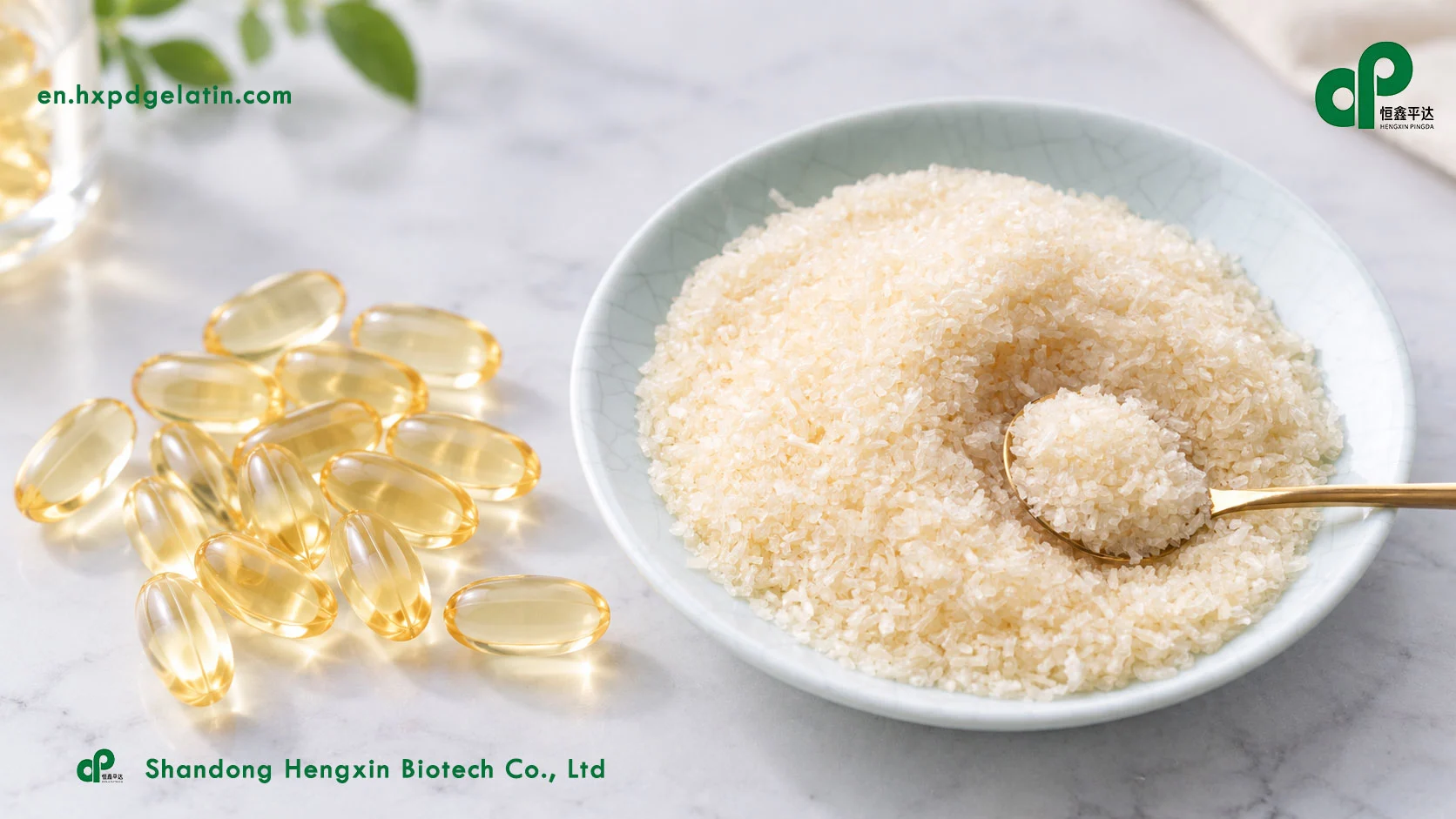
This article lays out a practical framework for structuring that comparison: what to check before the trial starts, what to measure during the run, and how to turn the results into a defensible sourcing decision.
"Gelatin grade" is really a bundle of three separate choices, and conflating them is the most common reason comparison trials go wrong.
Source material — bovine hide/bone, porcine skin, or fish (marine) collagen. Source affects gel strength, melting behavior, and market access (Halal, Kosher, BSE/TSE status).
Processing type — Type A gelatin is acid-processed (mainly porcine) and carries a net cationic charge at neutral pH; Type B is alkali/lime-processed (mainly bovine) and is net anionic. This affects compatibility with acidic or ionic fill actives.
Pharmacopoeia compliance — whether the lot is produced and tested against USP, European Pharmacopoeia (Ph. Eur. 0330) or China monograph requirements, versus a food-grade specification that happens to overlap on paper.
Before any trial, confirm which of these three variables is actually changing between the grades being compared. Swapping source and processing type and supplier in the same trial makes it impossible to attribute a result to any single cause. If you are still comparing material sources, certification needs, or general quality specifications, begin with our B2B gelatin selection guide.
A Certificate of Analysis (CoA) usually lists six to eight parameters. In a softgel context, these are the ones that translate directly into line performance:
Parameter | Typical softgel-grade range | Why it matters on the line? |
Bloom Strength | ~150-200 Bloom(vs. 200-260 for hard capsules). | Determines gel network strength, seam integrity and shell flexibility. |
Viscosity | Measured on a 6.67% w/w solution at 60°C, in mPa/s (cP). | Governs how the melted gel mass flows onto the casting drums. |
Moisture / loss on drying | Raw material generally ≤12% (pharma grade); in-process shell equilibrium is higher. | Affects ribbon workability and final capsule brittleness |
Ash Content | Typically <2% for pharmaceutical grade. | Reflects demineralization quality; influences clarity and long-term stability. |
pH | ~5.8–6.0 for bovine/porcine; ~3.9–5.2 for fish gelatin. | Fish gelatin's lower pH gives faster gastric dissolution but a weaker, more hydrolysis-sensitive gel. |
SO₂ residue & heavy metals | SO₂ commonly held under 50 ppm for pharma grade; Pb, As, Cd, Hg tested per Ph. Eur./USP limits. | Regulatory compliance and shelf-life; residual SO₂ can also affect ribbon color and odor. |
Bloom strength is tested with a standardized bloom gelometer — a 0.5-inch probe deflecting the gel surface by 4 mm, with the required force (in grams) reported as the Bloom value. Viscosity should always be compared at the same test concentration and temperature; a supplier quoting viscosity under different test conditions is not giving you a comparable number.
Two practical notes worth flagging to any evaluation team:
Ask for lot-specific CoA data, not the specification range. A spec sheet says "150–200 Bloom." The lot actually on your dock might be 155 or 195 — and those two lots will not run identically on a rotary die.
For bovine-derived gelatin, request a TSE/BSE declaration stating species, tissue type, country of origin, and compliance with the applicable regional regulation. This is a standard, low-friction document request — a supplier who cannot produce it quickly is a signal worth noting.
The gel mass recipe, plasticizer type and ratio (commonly glycerin or sorbitol at roughly 20–30% of shell formulation), fill formulation, machine settings, and room conditions should all stay fixed across the comparison. Only the gelatin grade should change.
A reasonable trial design:
Minimum three lots per candidate grade. Bloom and viscosity vary lot-to-lot even within one supplier's stated specification; a single-lot trial can't distinguish grade-level differences from ordinary batch variation.
Match environmental conditions. Encapsulation rooms are typically run at 25–30% relative humidity, with drying areas held tighter, around 20–25% RH. Run all candidate grades within the same shift or the same humidity window if possible — seasonal humidity swings alone can shift ribbon behavior enough to confound a comparison.
Hold plasticizer ratio constant unless you're deliberately testing an adjustment. If a lower-Bloom grade needs a different plasticizer ratio to hit target flexibility, that's a real finding — but note it explicitly rather than letting it happen as an unplanned side effect.
Gel mass and ribbon stage. After the fluff (gelatin, water, plasticizer) is melted under vacuum, the processing viscosity at 60°C is a useful early warning parameter — gel mass well outside a roughly 9,000–13,000 cP range at that temperature tends to signal either incomplete dissolution (too high) or dilution/degradation (too low), and either condition shows up downstream as ribbon defects. Watch for:
Brittle ribbons — often a sign of insufficient plasticizer or moisture relative to that grade's Bloom strength.
Tacky ribbons — usually tied to low ambient humidity or a gel mass running too hot.
Thickness drift — automated optical thickness monitoring on the casting drums should flag any grade that requires tighter tolerance control to hold a consistent ribbon gauge.
Encapsulation stage. Record fill weight variance, leaker rate, and shape retention. Pay particular attention to seam quality: the trailing edge of a rotary-die softgel can have a seam as thin as 20% of the shell's nominal wall thickness, making it the structural weak point where a lower-performing gelatin grade will show problems first. A seam burst test at this stage is more diagnostic than a visual pass/fail inspection alone.
Drying stage. Track the moisture-loss curve from tumble drying through tray/tunnel drying, and note the time required for each grade to reach target in-process moisture. A grade that dries unevenly or takes measurably longer to stabilize adds real cost even if its finished-capsule specs eventually look fine.
Once capsules are cured, the comparison should include:
Dissolution/disintegration testing. This is where pH and Bloom differences become clinically or functionally relevant — fish gelatin's lower pH and generally faster dissolution profile can be an advantage for fast-release formulations, but a disadvantage if formulation stability depends on a slower-dissolving shell.
Accelerated stability. Standard accelerated conditions (commonly 40°C/75% RH) over several weeks will reveal whether a grade's seam strength, shell clarity, or brittleness degrades faster than expected.
Defect rate under identical inspection criteria. Leakers, seam splits, and cosmetic defects should be tallied using the same acceptance criteria across all candidate grades, ideally by the same inspection team to remove rater variability.
Documentation completeness. Confirm each grade's supplier can provide lot-specific COA data, TSE/BSE declarations (where applicable), and Halal/Kosher certification if the target market requires it. A gelatin grade that performs well on the line but comes with incomplete documentation is not actually a viable option for regulated markets.
Changing more than one variable at once: swapping gelatin source and plasticizer ratio in the same run makes it impossible to attribute the result.
Testing a single lot per grade: normal lot-to-lot variation can be mistaken for a grade-level difference.
Ignoring the humidity window: comparing Grade A in a dry winter run against Grade B in a humid summer run isn't a fair test.
Trusting the spec sheet range instead of the lot's actual CoA values: the number that matters is what's in the drum on the day of the trial.
Stopping evaluation at capsule cure: some failure modes (seam weakening, brittleness, moisture migration) only appear after several weeks of accelerated storage.
Comparing gelatin grades is a process validation exercise, not a spec-sheet exercise. The grades that look identical on paper(same Bloom range, same "pharmaceutical grade" label), routinely produce different ribbon behavior, different seam strength, and different stability outcomes once they're actually run. A structured trial that isolates the gelatin variable, tracks performance at each production stage, and scores the results against the formulation's real priorities gives a manufacturer something a specification sheet never can: evidence.