 zh-CN
zh-CN

Mar 12-2025
The Versatile Applications of Hard Shell Gelatin Capsules in Biopharmaceuticals
READ MORE >
2026-08-27
Collagen is everywhere in the supplement and skincare world right now. Two terms show up over and over: marine collagen and collagen peptides. People often use these words like they mean the same thing. They do not. Marine collagen and collagen peptides are not two opposite types of collagen. Marine collagen describes the source. Collagen peptides describe the processed form.
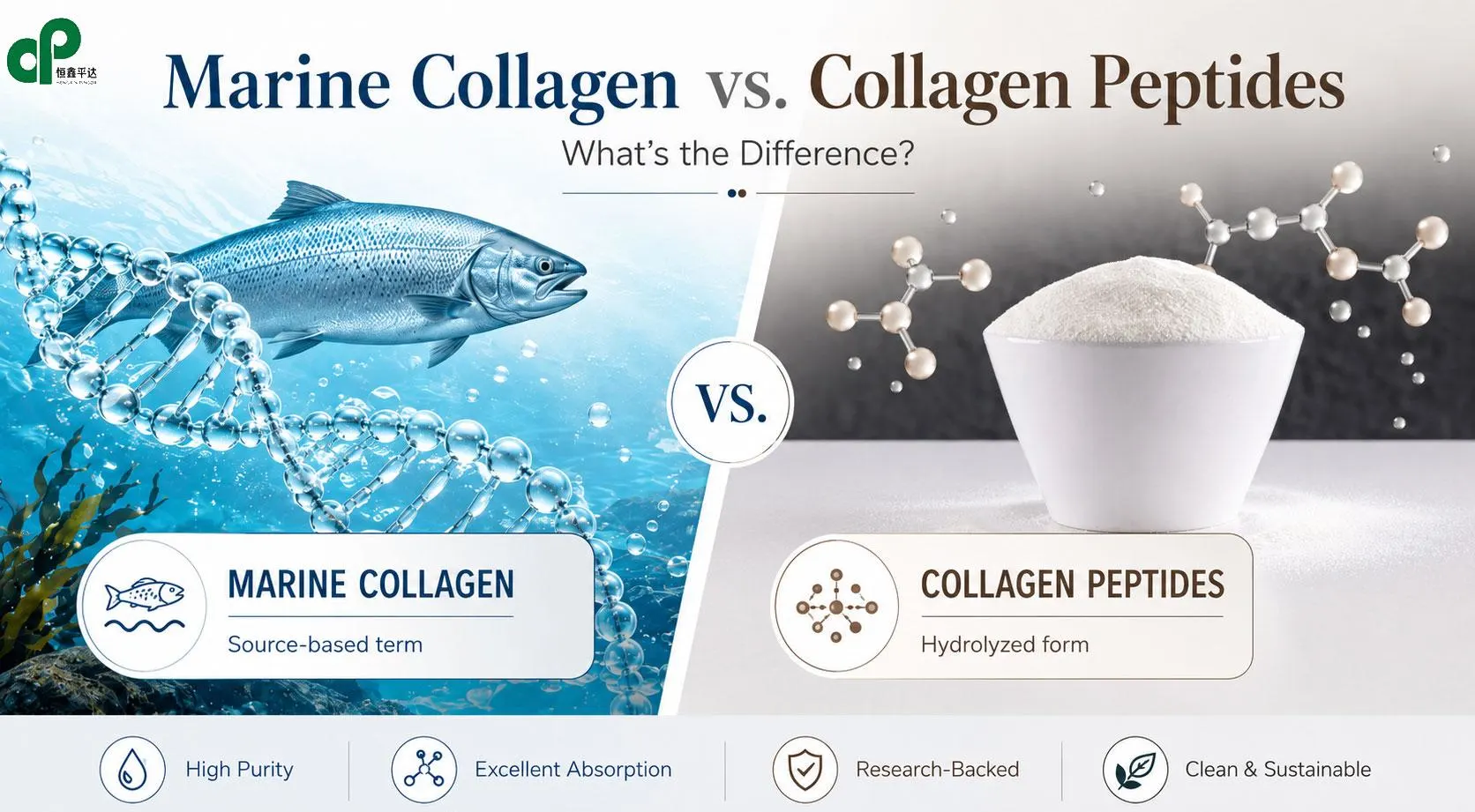
So, which is better: marine collagen or collagen peptides? Understanding their differences saves you lots of time. It also helps you make the right buying decision.
Marine collagen is a source. It comes from fish skin, scales, and bones.
Collagen peptides describe a form. This is collagen that has been broken down into smaller pieces through hydrolysis.
Marine collagen can be turned into collagen peptides. In fact, most marine collagen sold today is already hydrolyzed.
The real comparison is not "marine collagen vs. collagen peptides." It is "marine collagen vs. bovine or porcine collagen," paired with "hydrolyzed vs. non-hydrolyzed."
Compared with intact collagen, hydrolyzed marine collagen generally has better water solubility.
To compare these two terms fairly, we need to define them one at a time. They answer different questions. One answers "where does this collagen come from?" The other answers "what state is this collagen in?"
Marine collagen is collagen extracted from sea life. Most of it comes from fish: skin, scales, fins, and bones. Some marine collagen also comes from jellyfish or sponges, though fish sources dominate the market.
Fish collagen is mostly Type I collagen. This is the same collagen type found in human skin, tendons, and bones. That overlap is why marine collagen is popular in skincare and joint support products.
The extraction process matters a lot here. Manufacturers use acid, enzymes, or a mix of both to pull collagen out of raw fish material. The result is a protein with a fibrous, tightly wound structure, similar to collagen from land animals.
Collagen peptides are short peptide chains produced by breaking down collagen through hydrolysis. They are also commonly called hydrolyzed collagen or collagen hydrolysate. The term describes a process outcome, not an origin. Collagen peptides can come from several animal sources. These include bovine, porcine and fish.
These smaller peptides dissolve easily in cold water. They do not gel like unprocessed gelatin. This is why collagen peptides are the standard choice for drink mixes, coffee additives, and protein bars. The body can also absorb small peptides more easily than large, intact collagen molecules.
So, "collagen peptides" alone tells you nothing about the animal of origin. It only tells you the collagen has been broken down. For more detail on fish-derived collagen peptide specifications, molecular weight, and sourcing, read our guide to fish collagen peptides.
Hydrolysis is the manufacturing step that turns raw collagen into collagen peptides. Native collagen is a large, triple-helix protein. It is too big and too tightly structured for the body to absorb efficiently, and it does not dissolve well in cold liquid.
Hydrolysis breaks the bonds holding this large structure together. Enzymes act like scissors, cutting the long protein chain into short fragments. These fragments are called peptides. A finished collagen peptide product typically has a molecular weight between 1,000 and 5,000 daltons, compared to native collagen, which can weigh over 300,000 daltons.
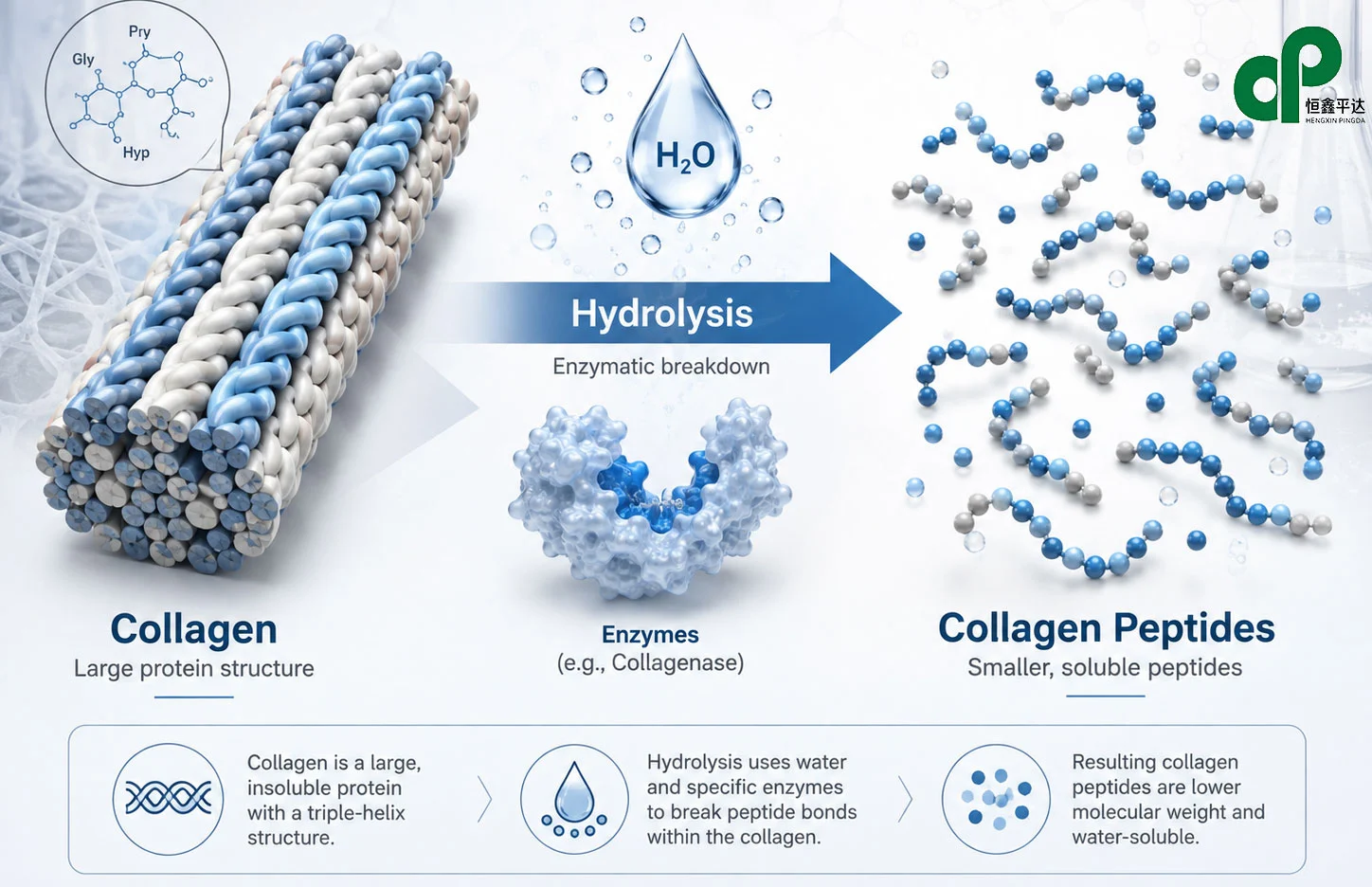
Industrial production processes can be simplified as follows:
1. Collagen-rich raw material
2. Collagen extraction and pretreatment
3. Protein structure becomes accessible
4. Hydrolysis
5. Shorter peptides
6. Purification and drying
This step significantly changes how collagen performs. Shorter peptides dissolve faster in cold water. This is why instant and cold-soluble collagen peptide supplements are available.
Manufacturers control several variables during hydrolysis to get a consistent, high-quality peptide product. Getting these wrong leads to bitter taste, poor solubility, or inconsistent molecular weight between batches.
Condition | What It Controls |
Enzyme type | Where the protein chain gets cut |
Temperature | Reaction speed and enzyme activity |
pH level | Enzyme performance and yield |
Reaction time | Final peptide chain length |
Filtration step | Removal of unreacted large proteins |
There is no single correct temperature or pH for all collagen peptides. Each protease works best under its own conditions. For example, pepsin operates in an acidic environment. Trypsin performs better under mildly alkaline conditions. This is why manufacturers must control the process according to the enzyme and the target peptide profile.
These conditions affect the degree of hydrolysis and molecular weight distribution of the finished product. Excessive hydrolysis can also change peptide composition and sensory properties. Therefore, a single average molecular weight does not fully describe product quality.
The main difference is classification. Marine collagen tells you where the collagen comes from. Collagen peptides tell you how the collagen has been processed.
Now we can compare these terms directly, using accurate categories instead of treating them as opposites.
Factor | Marine Collagen | Collagen Peptides |
What it describes | Source (fish, scales, skin) | Form (hydrolyzed, broken into small chains) |
Collagen type | Mostly Type I | Depends on source animal |
Molecular size | Can be large (native) or small (hydrolyzed) | Always small |
Solubility in cold water | Poor if not hydrolyzed | Disperses quickly |
Common sources | Fish, jellyfish, sponge | Fish, cow, pig, chicken |
Typical use case | Skincare, joint support | Beverages, protein blends, functional foods |
Sustainability angle | Uses seafood | Varies by source animal |
The table shows the key point clearly. Marine collagen tells you the raw material. Collagen peptides tell you the finished form. A product can be, and often is, both marine collagen and collagen peptides at the same time.
Benefits depend more on hydrolysis and the final peptide profile than on the source name alone. Still, some practical differences exist between marine and land-animal collagen sources.
Marine collagen can have a lower molecular weight after hydrolysis. This can improve dissolution and make them suitable for clear drinks, powders, and cold-water applications. It is mainly associated with Type I collagen. This makes it popular in beauty and skin-focused products.
Bovine collagen peptides commonly come from hide or bone and contain Type I and Type III collagen before hydrolysis. In practice, bovine peptides are widely used in general wellness, gummies, capsules, powders, and functional foods. They also tend to offer better cost efficiency.
Non-hydrolyzed marine collagen has a much larger molecular structure. It behaves differently from collagen peptides and has more limited use in standard food and beverage formulations.
The better answer is not one size fits all. It depends on your use case, budget, and audience.
For consumers, hydrolyzed marine collagen is a strong default choice. They mix easily into coffee, smoothies, and water. They match human skin collagen type. They also appeal to buyers avoiding beef or pork products for dietary or religious reasons.
For B2B buyers, the decision gets more technical. Marine collagen peptides usually cost more per kilogram than bovine collagen peptides. They are often selected for premium beauty products, clear beverages, and marine-source positioning. Bovine collagen peptides are usually more cost-effective. They work well in gummies, powders, capsules, tablets, and many functional food applications.
A practical sourcing decision starts with a few questions: What is the application? What solubility and molecular weight do you need? Does the target market require specific sourcing or certifications? What price can the formulation support?
These answers usually matter more than simply choosing one collagen source over another. For a deeper comparison, read our guide to marine vs. bovine collagen peptides.
No. Marine collagen is a source. Collagen peptides describe a hydrolyzed form. Marine collagen can be sold as collagen peptides once it goes through hydrolysis.
Only after hydrolysis. Raw marine collagen is a large protein. It becomes a marine collagen peptide once enzymes break it down into smaller chains.
This comparison mixes two different categories. A fairer question is whether marine or bovine collagen fits your goal better, and whether you need it hydrolyzed. For fast absorption and easy mixing, hydrolyzed peptides from any source usually win.
Yes. By definition, if a product is labeled "collagen peptides," it has already gone through hydrolysis, regardless of the animal source.
Commercial marine collagen peptides are most commonly made from fish skin, scales, and bones. These materials usually come from seafood processing byproducts.
Yes. Hydrolysis breaks collagen into smaller peptide chains and greatly improves water solubility. However, cold-water performance still depends on the product specification. Particle size, molecular weight distribution, concentration, and instantization can all affect how quickly the powder disperses.