
 zh-CN
zh-CN


Jun 15-2025
What You Need to Know About Gelatin Additives for Hard Capsules
READ MORE >
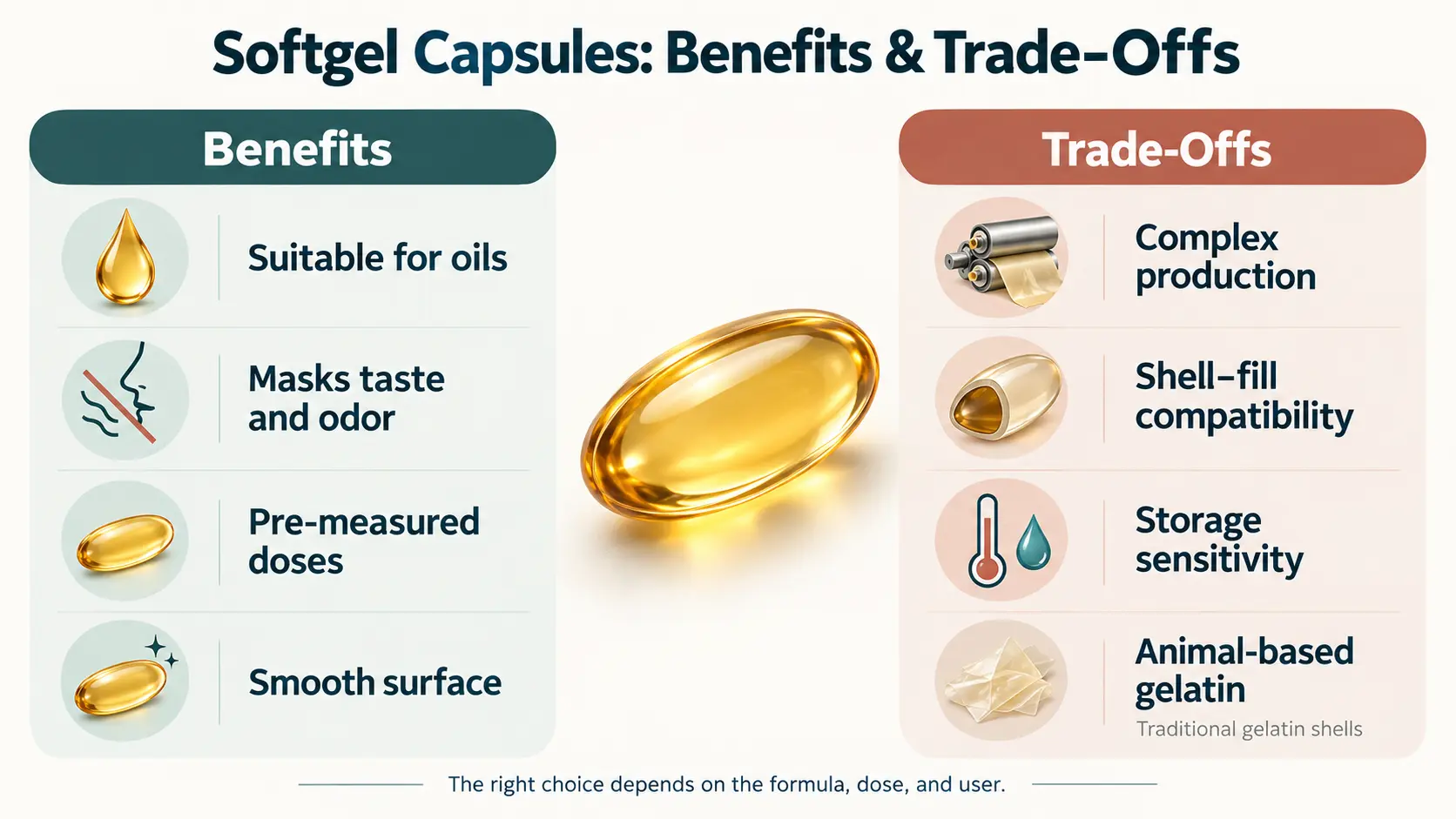
Softgel capsules can hold oils, liquids, and semi-solid formulas in a sealed shell. Their main advantages include taste masking, convenient dosing, and a smooth surface that may make swallowing easier. Some liquid formulas may also help certain ingredients dissolve and become available for absorption.
The main disadvantages are more complex manufacturing, limits on suitable fill ingredients, and sensitivity to storage conditions. Traditional gelatin softgels also use animal-based materials, which may not suit every market.
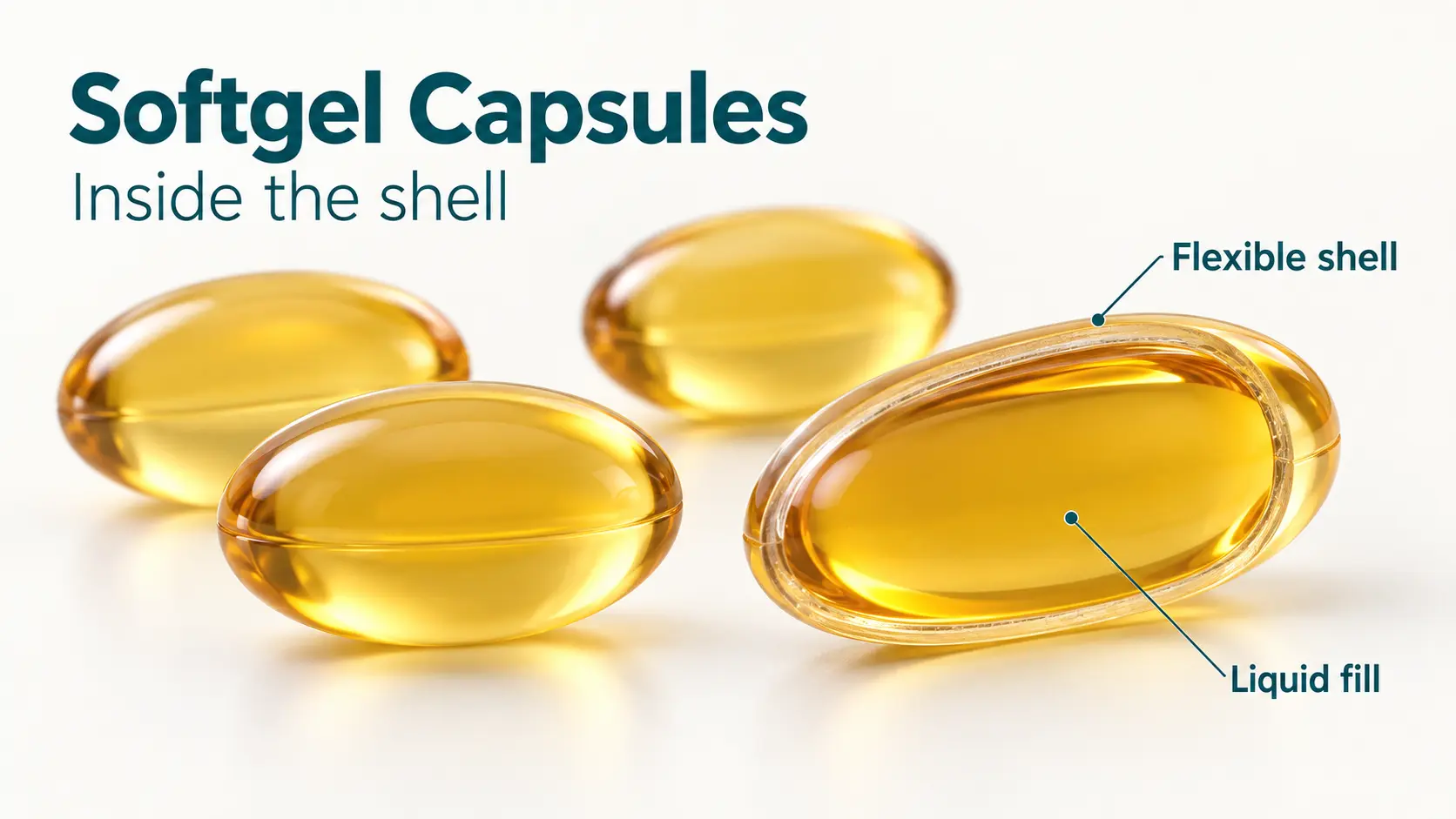
A softgel is a capsule with a flexible shell around a liquid, suspension, or semi-solid fill. A suspension is a liquid that contains small solid particles. A traditional softgel shell contains gelatin, water, and a plasticizer. Downstream customers of Hengxin Gelatin typically use glycerol or sorbitol as plasticizers. A plasticizer helps keep the shell flexible. The fill may contain an active ingredient mixed with oil or another suitable carrier. Fish oil and vitamin E are common examples. Non-gelatin softgels also exist. These use other shell materials and need their own formulation and process checks. For application details, explore our gelatin for softgel shells.
Softgels offer a practical way to turn an oil or liquid into individual doses. This makes them useful for fish oil, fat-soluble vitamins, and other ingredients that suit a liquid carrier. The ingredient may be dissolved in the fill or spread through it as small particles. The right choice depends on the ingredient and the finished product. This benefit is especially clear when comparing softgels with taking an oil directly from a bottle.
An intact shell keeps the fill from touching the mouth during normal swallowing. This can make strong-tasting oils and other unpleasant ingredients easier to take. However, taste masking has limits. A softgel doesn't guarantee that users will have no aftertaste or burping after taking the product. The fill, shell, and product design all matter.
Users do not need to measure a liquid with a spoon, cup, or dropper. They can follow instructions based on the number of capsules to take. For brands, this makes serving instructions easier to explain. For users, it removes a measuring step.
Softgels usually have a smooth surface and a rounded shape. Some people may find these features helpful when swallowing. Size remains important. A large softgel may be harder to swallow than a small tablet or hard capsule. Brands should consider the full serving, too. A product that requires several large capsules may offer less convenience than expected.
Some ingredients dissolve poorly in water. Placing them in a suitable liquid or lipid carrier may help them become available for absorption. Softgels can carry these formulas, but the shell alone does not create the benefit. Absorption depends on the active ingredient, the carrier, the dose, and how the formula behaves after it is swallowed. Claims of better absorption need evidence for the specific product.
In a common softgel process, two thin gelatin sheets are formed, filled, and sealed together. The fresh capsules then need controlled drying. Each stage can affect the next. Changes in shell thickness, fill behavior, sealing, or drying may lead to defects.
This requires special equipment, trained staff, and process control. These needs can add cost compared with simpler dosage forms. Actual cost also depends on batch size, formula, packaging, testing, and production yield.
The fill stays in contact with the shell throughout storage. Some fill components may move into the shell or change its properties.
For example, water and certain small molecules can move between the fill and shell. This may change shell firmness or flexibility.
Some reactive compounds can also cause gelatin cross-linking. This means extra chemical links form within the gelatin, which may slow the release of the fill during dissolution testing. Research on cross-linking. A formula that works in a bottle therefore needs testing before use in a softgel.
Heat, moisture, and dry conditions can affect softgel performance. Depending on the product, capsules may become sticky, soft, brittle, or misshapen. The fill also needs protection. Oils may oxidize, while some active ingredients may break down or come out of solution. A sealed shell does not provide complete protection from oxygen, moisture, or light. Packaging and storage instructions should be supported by stability testing.
Gelatin may come from bovine, porcine, or fish sources. These sources can affect whether a product suits certain diets or religious requirements. Fish gelatin is still animal-derived. It is not vegetarian or vegan.
Animal source alone also doesn't prove Halal or Kosher status. Buyers should check the relevant certificates and their scope. For more detail, read our guide to halal gelatin sources and certification. Non-gelatin softgels may offer another option, but switching shell materials requires testing.
Each softgel contains a fixed amount of fill. This is useful for routine dosing, but it offers less flexibility than a measured liquid. A high dose may require a larger capsule or several capsules per serving. Both can affect user acceptance. This matters early in product development. A formula may fit inside a softgel while still creating an inconvenient finished product.
Start with the formula and the intended user. Then compare realistic dosage-form options.
Product Need | What to Consider |
An oil-based formula | Softgels are a practical option worth evaluating |
Strong taste during use | An intact softgel can reduce contact with the mouth |
A high-dose dry powder | Compare tablets and hard capsules before choosing a softgel |
Flexible dose adjustment | A measured liquid may offer more flexibility |
A vegan product | Assess suitable non-animal shell options |
A tight production budget | Compare total development and manufacturing costs |
A formula that reacts with gelatin | Test compatibility or consider another shell or dosage form |
Some hard capsules can also hold suitable liquid or lipid formulas. Liquid filling is therefore not unique to softgels. Study of lipid formulas in hard capsules.
The comparison should also be fair. A softgel may be more convenient than bottled oil, but that does not mean it is easier to use than every tablet. Before choosing a dosage form, answer four questions:
Can it carry the required dose in a practical size?
Will the formula remain stable inside it?
Can the product be made at the required quality and cost?
Does it fit the target user and market?
A softgel's advantages depend on the shell and fill working together. Gelatin forms the shell structure. The plasticizer provides flexibility. Water helps the shell form during production, and its balance remains important after drying.
During manufacturing, these materials form thin ribbons. The equipment brings the ribbons together, adds the fill, and seals the capsule. Drying then brings the capsule to its intended finished condition.
This process explains several common trade-offs:
Desired Result | What Must Be Controlled |
A flexible shell | Shell formula and moisture balance |
Reliable containment | Ribbon formation and seam quality |
A consistent dose | Fill accuracy and formula uniformity |
Stable storage performance | Shell–fill compatibility and packaging |
Proper release | Shell behavior and the fill’s performance |
Gelatin quality matters, but it is only one part of the process. A leaking or brittle capsule should not automatically be blamed on the gelatin. The fill, machine settings, drying process, and storage conditions may also need review. Before selecting a grade, learn how to compare gelatin grades in a softgel production trial.
A clear, glossy capsule can still have quality problems. Buyers should ask for evidence that supports the claims made about the finished product.
Physical Integrity: Check for leakage, cracks, weak seams, sticking, and unusual softness or brittleness. These checks help show whether the capsule can withstand normal handling. They do not prove that the active ingredient is stable or present at the correct level.
Dose Consistency: Fill weight shows how much material is inside the capsule. Active-content testing shows how much of the intended ingredient is present. The difference matters in suspension formulas. If particles settle during filling, capsules with similar weights could contain different amounts of active ingredient.
Disintegration and Dissolution: Disintegration checks how the dosage form breaks apart under set test conditions. Dissolution measures how much of the active ingredient dissolves in a test liquid over time. A shell opening does not prove that its contents have fully dissolved. The required tests depend on the product and the standards that apply to it.
Stability in the Proposed Packaging: Ask whether testing supports the intended shelf life in the packaging that will be sold. Relevant checks may include shell condition, active content, breakdown products, and release performance. Oil-based products may also need suitable oxidation tests.
Material and Market Documents: Review material specifications, test results, and traceability records. Check source declarations and religious certificates when relevant. A gelatin supplier’s certificate supports raw-material evaluation.
Not always. A suitable liquid formula may help certain ingredients dissolve or become available for absorption. The result must be assessed for the specific product.
They can contain solid particles dispersed in a liquid as a suspension. They are not normally filled with loose dry powder in the same way as standard hard capsules.
No. Non-gelatin shell systems are available. Traditional gelatin softgels, however, use animal-derived gelatin.
Possible causes include moisture changes, storage conditions, shell composition, and interactions with the fill. Finding the cause requires checking the product and its handling history.
No. Softgels are useful for many oil and liquid formulas, but the best choice depends on dose, stability, cost, market needs, and ease of use. For a new product, begin with the fill formula and target serving size. Then confirm shell compatibility, manufacturing performance, and stability before selecting the final dosage form.