 zh-CN
zh-CN


Dec 11-2024
The Ultimate Guide to High Quality Collagen Infused Foods
READ MORE >
2026-08-14
You are buying fish collagen peptides in bulk. The supplier hands you a Certificate of Analysis. Now what? A COA is a test report. It tells you if the product meets your specifications. But you need to understand what the numbers actually mean. This guide explains how to read a fish collagen peptide COA. It focuses on the data, the test methods, and the calculations behind each number.
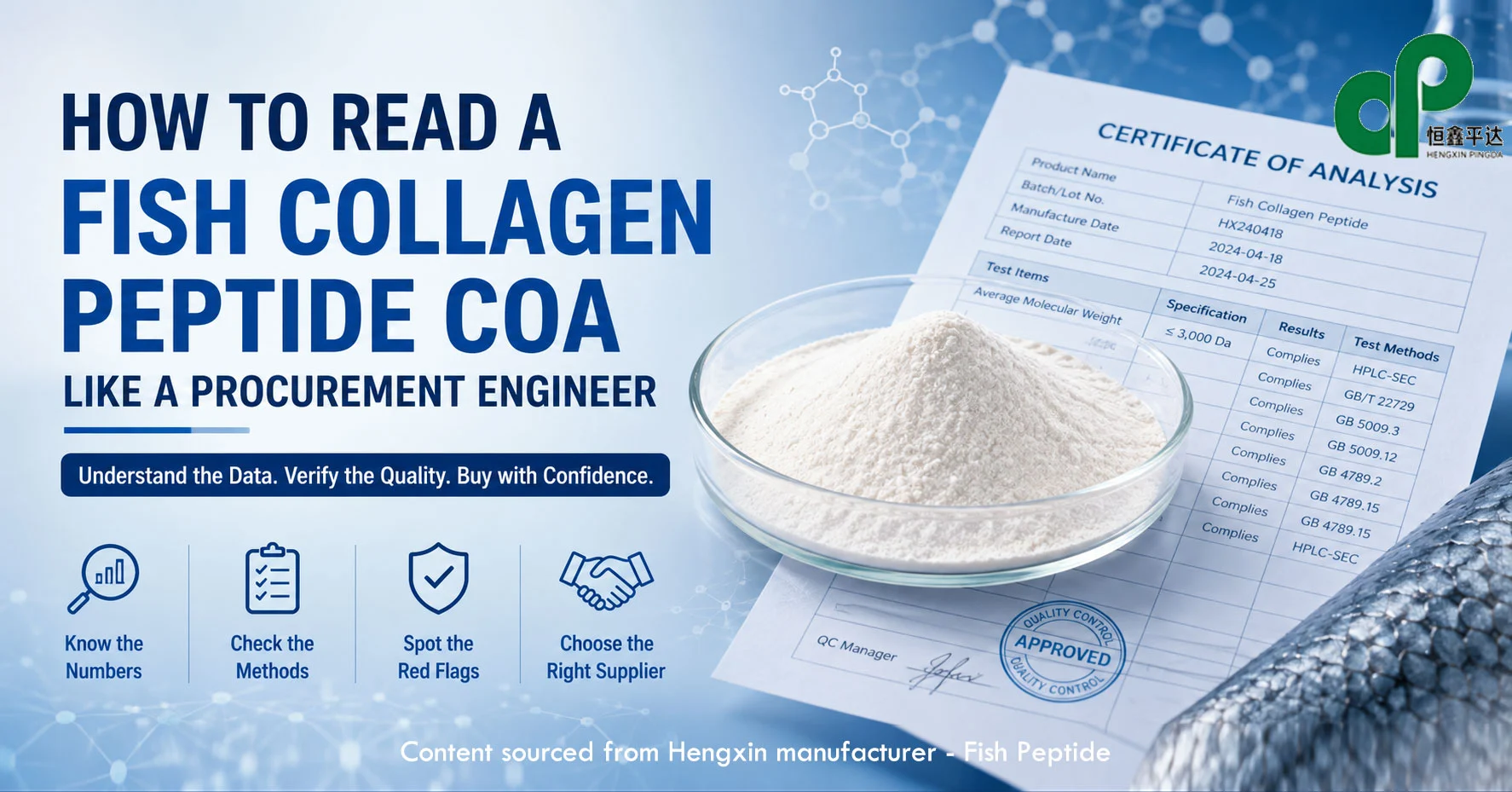
If you arrived here from our sourcing guide, this article picks up where that one left off: you have identified potential supplier. Now you need to evaluate what they are actually selling you.
Check the batch first: Make sure the COA matches your actual shipment and includes test methods.
Focus on molecular weight: Review the full molecular weight distribution, not just the average.
Verify collagen identity: Check hydroxyproline and the amino acid profile.
Compare quality consistently: Check protein basis, moisture, ash, heavy metals, and microbial results.
Watch for red flags: Missing data, incomplete test results, or unexplained specifications deserve further verification.
Every COA has header information. Do not skip it. Look for these items:
Product name and description.
Batch or lot number.
Manufacturing date and retest date.
Specification limits and actual results.
Test methods (with standard references).
Laboratory name and accreditation.
The batch number is critical. Match it to the product you receive. A COA from a different batch is worthless for your shipment.
If you're short on time, this is the single most critical section to evaluate. Molecular weight distribution affects how fish collagen peptides perform in a finished product. It can influence solubility, taste, processing behavior, and peptide absorption.
Fish collagen peptides come from the enzymatic hydrolysis of Type I collagen from fish skin or scales. The enzyme system, temperature, pH, and reaction time control the size of the resulting peptides. Molecular weight is reported in Daltons (Da) or kilodaltons (kDa). A useful specification should show both the average molecular weight and the distribution.
Example specification
"Average molecular weight: ≤ 3,000 Da"
"Peptides below 5,000 Da: ≥ 90%"
The average value gives you one number for the batch. The distribution shows how the peptides are spread across different molecular weight ranges. For many dietary supplement applications, products below 3,000 Da are commonly used. Applications such as beverages and liquid shots may require lower molecular weight ranges to support dissolution and formulation performance. Very small peptides can affect taste and sensory performance. Higher-molecular-weight fractions can affect solubility and formulation behavior.
The test method matters when you compare molecular weight data from different suppliers:
HPLC-SEC is widely used to measure the molecular weight distribution of collagen peptides. The method separates peptides by size and uses calibration standards to estimate their molecular weight. HPLC can show the distribution across different molecular weight ranges. This makes it useful for routine quality control and batch-to-batch comparison.
MALDI-TOF MS measures the mass of peptide ions directly. It can provide higher resolution for certain low-molecular-weight peptide fractions and works well as a complementary analytical method.
SDS-PAGE is more suitable for larger proteins. Its resolution is limited for highly hydrolyzed collagen peptides, so it should not be the only method used to characterize a low-molecular-weight peptide product.
Don’t ask for the average molecular weight alone. Request the HPLC chromatogram or molecular weight distribution report when you need to evaluate batch consistency. A narrow distribution can indicate better control of the hydrolysis process. A broad distribution or a large high-molecular-weight fraction may require further investigation. Lastly, compare third-party test data to further verify the molecular weight data provided by the supplier.
Hydroxyproline (Hyp) is abundant in collagen and is less common in most other proteins. It can be used as a marker when evaluating collagen-containing materials. A low Hyp result does not prove adulteration. It should trigger further checks of the raw material source, product composition, and test method.
Test Method: Laboratories can measure Hyp after acid hydrolysis and colorimetric analysis. The exact procedure and calculation should be stated in the test report.
The calculation:
Hydroxyproline (%) = (C × V × D) / W × 100
l C = concentration from standard curve (mg/mL)
l V = total volume of test solution (mL)
l D = dilution factor
l W = sample weight (mg)
Hyp content varies with collagen source and processing conditions. A reported value should always be evaluated against the raw material and analytical method.
Protein content is one of the first numbers buyers check on a COA. It does not tell you how the value was calculated. Kjeldahl or Dumas methods measure nitrogen and convert it to protein using a conversion factor.
The calculation: Protein (%) = Total Nitrogen (%) × Conversion Factor. Always check the conversion factor and reporting basis. A result reported on a dry basis will be higher than the same sample reported as received.
Wet basis (as-received): No water removal. Lower values reflect actual protein content of delivered goods.
Dry basis: Calculated after excluding water weight. Yields higher values.
For example, a sample with 92% protein on a dry basis and 7% moisture contains about 85.6% protein on an as-received basis.
Use the same reporting basis when comparing suppliers. This prevents misleading price and quality comparisons.
Collagen powder solubility is an important metric for clear beverages and oral liquid formulations. Compared to bovine collagen peptides, fish peptides typically exhibit better solubility in cold water under the same processing conditions.This difference is related to their molecular structure and physical properties. If you are deciding between marine and bovine sources, see our marine vs. bovine collagen peptide comparison for differences in formulation performance, labeling, certification requirements, and cost.
Hengxin fish collagen peptides provide a real-world example: At 20°C, a 10% solution dissolves completely within 1–2 minutes of stirring, with no visible residue.
Moisture: High moisture promotes microbial growth and reduces shelf life. Test method: Oven drying at 105°C until constant weight. Calculation of fish peptide: Moisture (%) = (Weight loss / Initial sample weight) × 100
Ash is inorganic residue after burning. High ash means high mineral content — often from bone or scale contamination. How to test: Muffle furnace at 550–600°C until all organic matter is burned off.
These specifications carry regulatory weight. They also tell you something about the supplier's raw material sourcing and hygiene. Fish accumulate heavy metals from water. Reputable suppliers maintain fully traceable raw material sources and conduct testing for every batcAsk whether the supplier can trace the raw material to its source and provide batch-specific test results.
The test method should also be listed. ICP-MS is commonly used when low detection limits are required. Heavy metal limits depend on the target market and product application. Ask the supplier for the applicable specification and the individual test results.
Example Heavy Metal Parameters:
Heavy Metal | Typical Limit | Method |
Chromium(Cr) | ≤2.0 mg/kg | ICP-MS or AAS |
Lead(Pb) | ≤1.0 mg/kg | ICP-MS or AAS |
Total Arsenic(As) | ≤1.0 mg/kg | ICP-MS or AAS |
Cadmium(Cd) | ≤1.0 mg/kg | ICP-MS or AAS |
Total Mercury(Hg) | ≤1.0 mg/kg | ICP-MS or AAS |
Low moisture and low water activity can help limit microbial growth in collagen peptide powder. Final microbial safety still depends on drying, handling, packaging, storage, and process hygiene.
Example Standard limits:
Parameter | Limit |
Total Bacteria Count | ≤1,000–3,000 CFU/g |
Coliforms | ≤ 10 CFU/g |
Salmonella | Absent in 25g |
These tests are only routine checks. If your private-label brand requires a stricter, more comprehensive COA, specify the requirements in the supply agreement. Manufacturers like Hengxin will typically work with you to meet these specifications.
Pull any COA from your supplier and check for these elements:
A. Lot/batch number.
B. Manufacturing date.
C. Expiry/retest date.
D. Test results with units.
E. Test method references.
F. Analyst signature or electronic approval.
G. Laboratory accreditation information.
Don't judge a supplier by protein content alone. Check these five points before approval.
No Molecular Weight Data: The COA provides no molecular weight information. You cannot verify the peptide size or distribution.
Average Molecular Weight Only: COA reports only an average value. Request the molecular weight distribution to see how the peptides are distributed.
No Nitrogen Conversion Factor: The supplier reports protein by Kjeldahl or Dumas but does not state the conversion factor. The factor directly affects the reported protein value.
No Individual Heavy Metal Results: The COA only states that the product meets a general standard. Request individual results for lead, cadmium, arsenic, and mercury when these parameters are part of your specification.
Amino Acid Profile Doesn't Match Collagen: Collagen peptides typically contain high levels of glycine, proline, and hydroxyproline. An unusual amino acid profile should trigger further verification.
How do I verify that the COA data is real and not fabricated?
Start with the batch number, test method, laboratory information, and original test report. For critical parameters, request supporting analytical data such as the HPLC chromatogram or third-party test report. Batch-to-batch variation is normal. Identical results across multiple batches deserve further review.
What specification differences should I expect between fish scale collagen and fish skin collagen?
Fish skin collagen typically yields a slightly higher molecular weight distribution and a marginally different amino acid profile — skin contains more Type I collagen with higher hydroxyproline content. Fish scale collagen often contains more ash (mineral residue from the scale structure) unless the supplier runs additional demineralization steps. Both sources produce functional collagen peptides; the choice between them depends on your target application, desired molecular weight profile, and your market's regulatory requirements for raw material origin.
A COA is more than a pass/fail document. It gives procurement a way to check product consistency, test methods, and supplier transparency. Before approving a fish collagen peptide supplier, check the molecular weight distribution, hydroxyproline, protein calculation, heavy metals, microbiological results, and batch information. Always match the COA to the actual batch you receive.