 zh-CN
zh-CN




Aug 06-2026
How to Source Fish Collagen Peptides from China: 2026 Guide for Global Buyers
READ MORE >
2026-07-30
Fish collagen peptides have moved from a niche ingredient to a mainstream input for supplement, food, and cosmetic brands. Buyers now ask sharper questions before they sign a purchase order. What are fish peptides, exactly? Which fish species go into the powder? How does a fish peptide manufacturer control quality batch after batch?
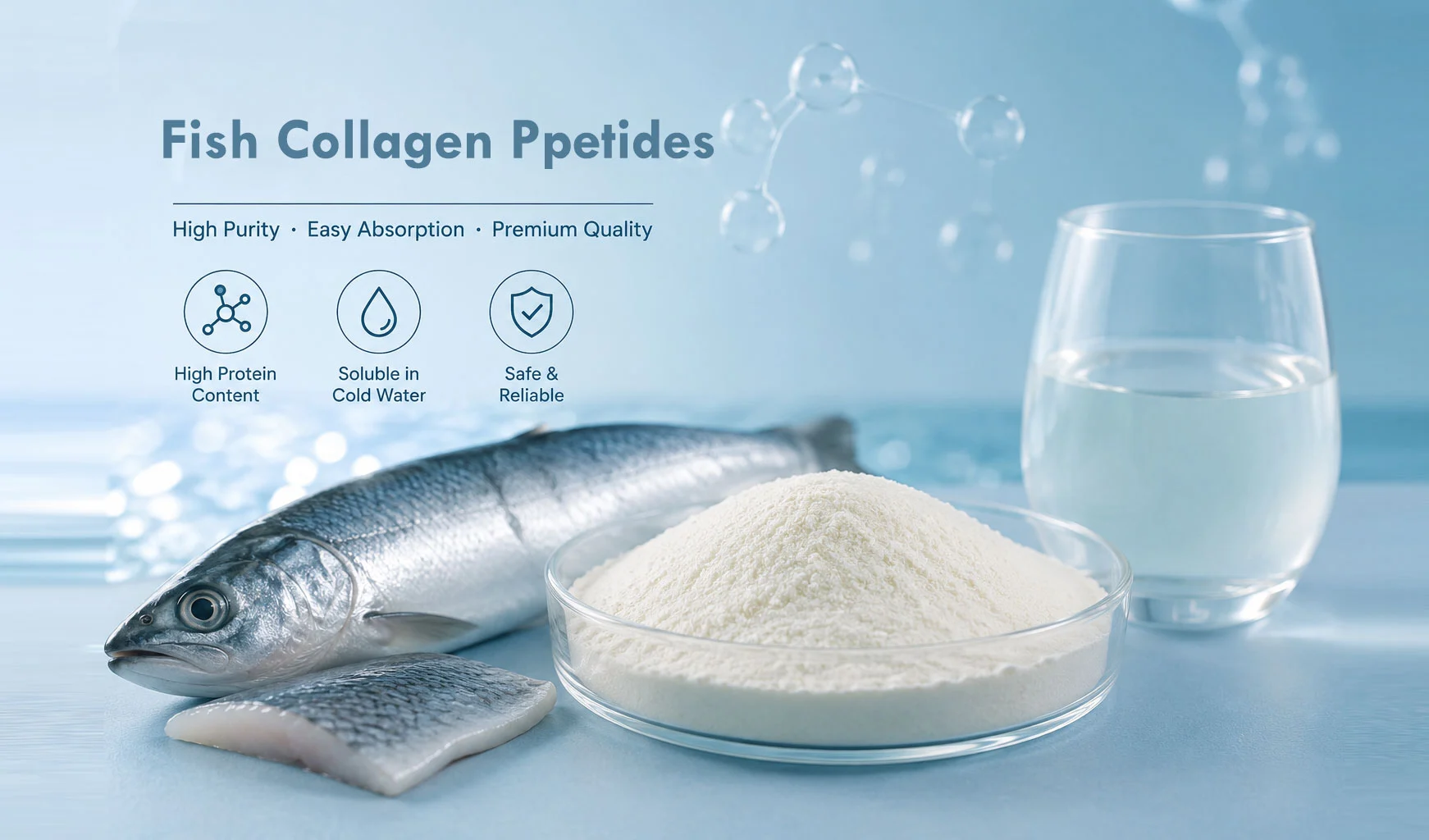
This guide answers those questions in plain terms. It walks through what fish collagen peptides are, how they differ from other collagen peptides, where fish peptide powder comes from, and how a B2B buyer can vet a manufacturer before committing to a contract.
Collagen is a structural protein. It holds skin, bone, cartilage, and connective tissue together in humans and animals. It makes up roughly a third of all protein in the human body.
It exists in several types. Type I is the most common. It sits in skin, tendons, and bone, and it is the type most B2B buyers care about for food, supplement, and cosmetic applications.
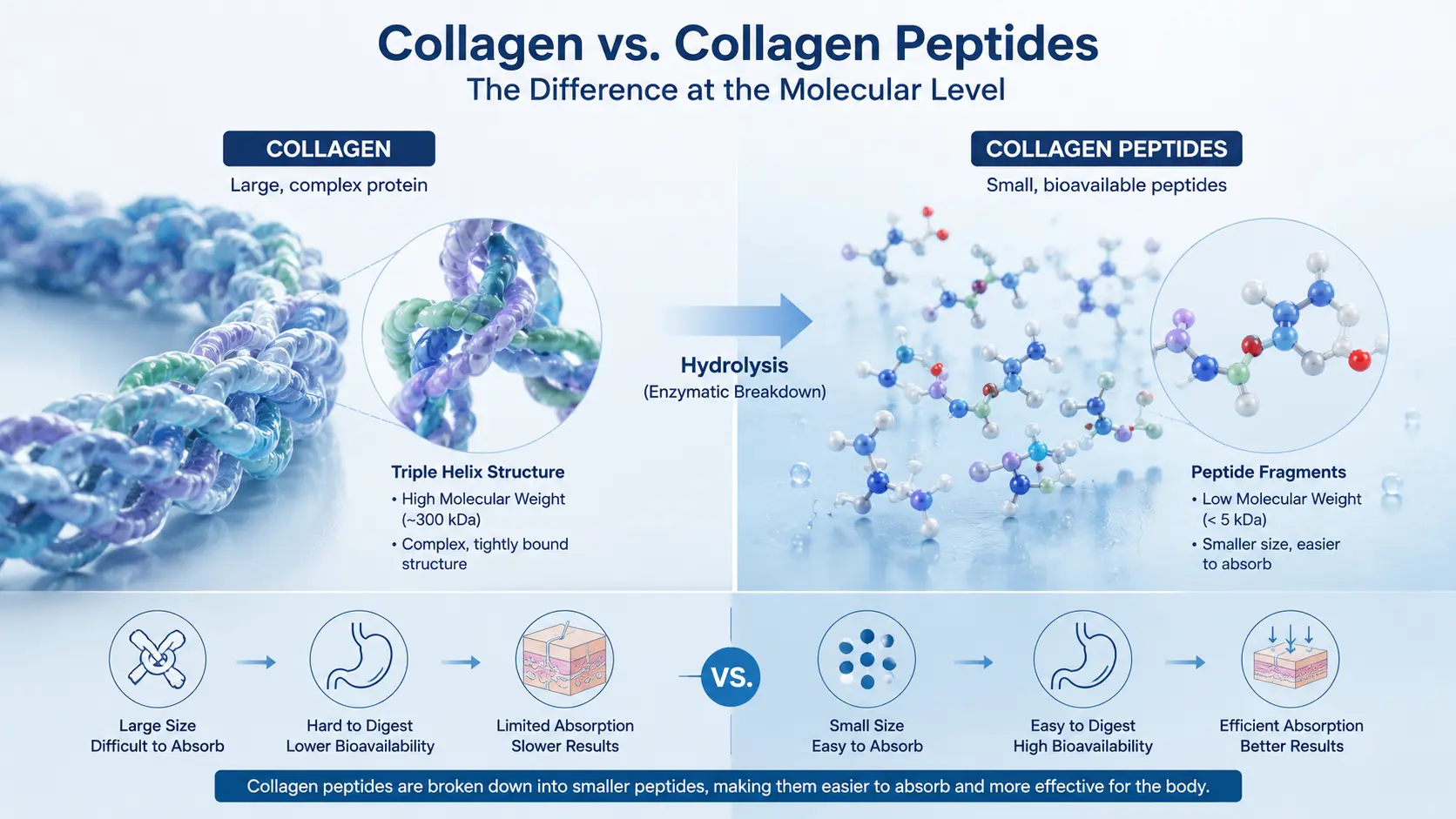
In its natural state, collagen is a long, tightly wound protein chain. That size makes it hard for the body to absorb and hard for manufacturers to dissolve into a clear liquid or a stable powder. This is the problem that collagen peptides solve.
Collagen peptides are collagen that has been broken down into shorter chains of amino acids. Manufacturers use enzymes or acids to cut the long collagen molecule into smaller pieces. This process is called hydrolysis, so collagen peptides are also called hydrolyzed collagen.
The smaller chain size gives collagen peptides three practical advantages over raw collagen: they dissolve in cold water, they carry little to no taste or odor once processed correctly, and the body absorbs them faster.
Producers source collagen peptides from several raw materials, including bovine hide, pig skin, and fish skin, scales, or bones.
So, what are fish peptides? Fish collagen peptides are simply small-molecule products derived from the further enzymatic hydrolysis of fish collagen. Manufacturers subject the raw materials to enzyme treatment under controlled low-temperature conditions to break down collagen into short peptide chains, followed by filtration, concentration and drying to produce the final fish peptide powder.
Hengxin manufacturers premium Type I collagen, ideal for cosmetic formulations and nutritional health supplements.
“Collagen peptides” is the broad category. Marine collagen peptides are one source inside that category, alongside bovine and porcine peptides. The hydrolysis process is similar across all three. The raw material and the resulting molecule size are what set fish peptides apart.
The essential difference between fish peptides and fish collagen comes down to molecular size, absorption rate, and use case. Fish collagen is the raw protein structure, while fish peptides are collagen that's been further broken down (hydrolyzed) into smaller chains. See our guide to marine collagen vs. collagen peptides for a clearer explanation of how the two terms relate.
Hengxin's fish collagen peptides come in under 3,000 daltons, with some grades below 1,000 daltons. Lower molecular weight generally means faster dissolution and absorption, that you can match the grade to your formulation and processing needs.
Fish collagen peptides also carry no risk of transmitting diseases linked to land animals, such as bovine spongiform encephalopathy. That single point drives a meaningful share of B2B demand, especially from buyers selling into markets with strict animal-product restrictions.
Purchasers choosing between fish, bovine, and porcine peptides are really choosing between four variables: bioavailability, religious and dietary compliance, cost, and supply chain story. Here is how the three sources compare on the factors that matter most in a sourcing decision.
Factor | Fish Collagen Peptides | Bovine Peptides | Porcine Peptides |
Typical molecular weight | Low; often under 3 kDa | Moderate to low when well hydrolyzed | Moderate to low when well hydrolyzed |
Halal / Kosher fit | Straightforward for most species | Requires certified slaughter | Not halal or kosher |
Relative cost | Higher | Lower | Higher |
Disease-transmission risk | None from land-animal disease | Low, but a known concern (BSE) | Low, but a known concern (swine disease) |
Best-fit end use | Premium beauty, clean-label food, pescatarian diets | Sports nutrition, joint-health formulas at scale | Cost-sensitive mass-market supplements |
For a more detailed source comparison, review marine vs. bovine collagen peptides.
None of the three sources is universally “better.” Some clinical studies have used a mix of all three sources, and all showed consistent, positive results. The right choice comes down to your target market, label claims, and budget ,not on an absorption value number. For example, a formulator focused on the Muslim market really only has one option: peptides carrying Halal or Kosher certification.
Fish peptides are mainly sourced from tilapia, cod, salmon, pollock and pangasius. The raw materials used are fish skin, fish scales and fish bones leftover from fish meat processing plants.
Tilapia is the most common source worldwide. It is farmed at high volume, its skin holds a high percentage of collagen, and its supply is stable year-round. Deep-sea and cold-water species, including cod, salmon, and pollock, are prized for skin quality and for a “wild-caught” or “deep-sea” label claim. Pangasius is also used by manufacturers based in Southeast Asia.
The species matters for one technical reason beyond marketing: collagen from cold-water fish, such as salmon, has a lower denaturation temperature than collagen from warm-water fish, such as tilapia. That affects how the raw material behaves during extraction and can influence the final product's stability. A buyer sourcing for a specific application should ask which species the powder came from. If you're evaluating fish collagen peptide ingredient suppliers, request the COA for Hengxin's fish collagen peptides or contact us to discuss your sourcing requirements and technical specifications.
Fish peptide powder shows up across four buyer segments:
Nutraceuticals and dietary supplements — capsules, tablets, and drink mixes marketed for skin, joint, and bone support.
Functional food and beverage — collagen-fortified drinks, gummies, bars, and dairy products.
Cosmetics and personal care — serums, creams, and masks that use fish peptides for their skin-matching Type I collagen profile.
Pharmaceutical and medical nutrition — wound-care products and clinical nutrition formulas.
According to a report by Global Market Insights Inc., the global fish collagen peptides market is projected to grow from $913.7 million in 2026 to $1.8 billion by 2035, expanding at a compound annual growth rate (CAGR) of 7.5%.
This growth is driven by rising consumer demand for clean-label, natural, and minimally processed health and wellness ingredients. It also signals fiercer competition among reliable suppliers.
Highly competitive environment brings significant opportunity—brand owners who have already established a foothold stand to reap substantial rewards.
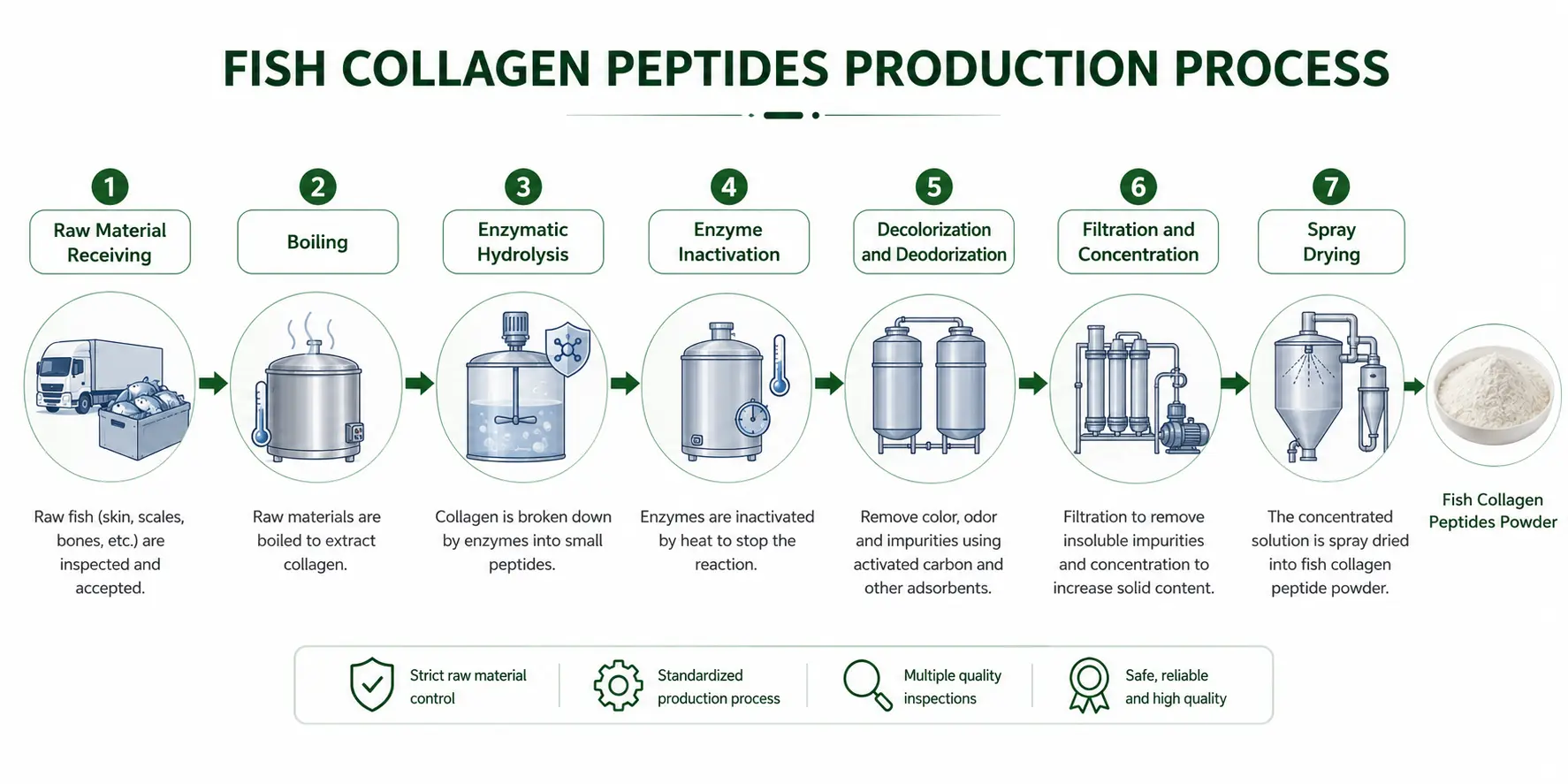
Producing fish peptide powder follows a consistent sequence, whether the manufacturer starts with skin, scale, or bone.
Raw material intake: fresh or frozen fish skin, scale, or bone arrives from processing plants and is thawed, washed, and descaled.
Cooking: Precisely regulate temperature and duration to fully extract collagen from raw materials.
Enzymatic hydrolysis: food-grade enzymes break the collagen into short peptide chains at a controlled, moderate temperature. This step, not heat alone, is what turns collagen into collagen peptides.
Enzyme inactivation: the mixture is briefly heated to stop the enzymatic reaction at the target chain length.
Decolorizing and deodorizing: activated carbon and filtration remove color and fishy odor.
Filtration and concentration: membrane filtration removes solids and concentrates the peptide solution.
Spray drying: the concentrated liquid is spray-dried into the fine, off-white fish peptide powder that ships to buyers.
Our collagen peptides production process:
Based on our experience of over 20 years, brands evaluating fish collagen peptides typically pay more attention to molecular weight distribution, product stability, and batch consistency. That's why we encourage buyers to review production records and test samples before making a purchasing decision.
We know that fully understanding client requirements and fine-tuning production parameters are critical to protecting your product quality and supporting long-term growth.
For long-term supply projects, many buyers choose to conduct a factory audit or arrange a third-party inspection before final supplier approval.
A strong batch of fish peptide powder should meet these baseline characteristics:
Protein content above 90%, confirmed by a certificate of analysis.
Molecular weight concentrated in a narrow, stated range, typically below 3,000 daltons for fast-dissolving applications.
Neutral color and low odor — a strong fishy smell usually signals incomplete deodorizing.
Full solubility in cold water with no clumping or sediment.
Heavy metal and microbial testing results within the limits set by your target market's food or cosmetic regulations.
A documented amino acid profile, since glycine, proline, and hydroxyproline content indicate genuine collagen-derived peptides rather than diluted protein blends.
See how collagen peptides perform in a beverage application in the video below:
In our experience, consistent quality matters more than a single specification. Many B2B brand owners evaluate batch-to-batch consistency alongside protein content and molecular weight before selecting a long-term supplier. Explore our Fish Collagen Peptides to learn more about available specifications and customization options.
Beyond the product specification sheet, a handful of business factors decide whether a supplier relationship works long term.
Traceability: can the supplier confirm the fish species and the country of origin for every batch?
Certifications: does the product carry the certifications your market requires, such as Halal, Kosher, ISO 22000, or HACCP?
Batch-to-batch consistency: ask for certificates of analysis from several past batches, not just one sample.
Minimum order quantity and lead time: confirm these match your production schedule before you commit to a formulation around one supplier.
Regulatory documentation: confirm the supplier can provide the safety data sheets, allergen statements, and country-specific registration documents your market requires.
Price stability: ask how the supplier handles raw material price swings, since fish byproduct costs can move with the broader seafood market.
The product spec sheet tells you what a fish peptide manufacturer claims to produce. The manufacturer's operation tells you what they can actually deliver at scale.
Request a facility audit or a recent third-party audit report, rather than relying on marketing claims alone.
Check for GMP or ISO certification specific to food or cosmetic ingredient manufacturing.
Ask for in-house R&D capability if you need a custom molecular weight range or a private-label formulation.
Test a sample batch under your own lab conditions before signing a long-term contract.
Confirm the manufacturer's raw material supply chain — a company that owns or has long-term contracts with fish processing plants is less exposed to sudden shortages.
Review references from existing B2B customers in your industry, not just consumer testimonials.
A manufacturer who answers these questions directly, with documentation, is a stronger long-term partner than one who only offers a low price.
Fish peptides are used in supplements, functional foods, cosmetics, and medical nutrition products. Brands add them to formulas that target skin, joint, and bone health, and to clean-label products aimed at pescatarian or halal and kosher markets.
Tilapia is the most common source because of its large, stable supply and high collagen content in the skin. Cod, salmon, pollock, and pangasius are also widely used, often as a premium or “deep-sea” positioning.
No single source is better for every use case. Fish collagen peptides generally have a lower molecular weight and fit halal, kosher, and pescatarian requirements more easily. Bovine and porcine peptides are usually lower cost and have a larger published research base at higher daily doses. The right choice depends on your target market and product positioning.
Request a certificate of analysis covering protein content, molecular weight distribution, heavy metals, and microbial limits. Then test a sample batch in your own lab or pilot production run before committing to a large purchase order.
Look for documented certifications (ISO, HACCP, Halal, Kosher), a traceable raw material supply chain, consistent batch-to-batch testing, and a willingness to provide samples and facility documentation before you sign a contract.