 zh-CN
zh-CN


Aug 15-2026
How to Read a Fish Collagen Peptide COA Like a Procurement Engineer
READ MORE >
A tub of Vital Proteins Collagen Peptides starts with an ingredient that sounds far removed from a morning smoothie: bovine hide. The company identifies it as the source of its collagen peptides. Elsewhere on supplement shelves, collagen products carry labels such as "Type I & III," "Type II," or "Multi-Collagen." These labels describe different parts of the product. Bovine hide names the source. Type I or III identifies the original collagen. "Peptides" describes the material after processing.
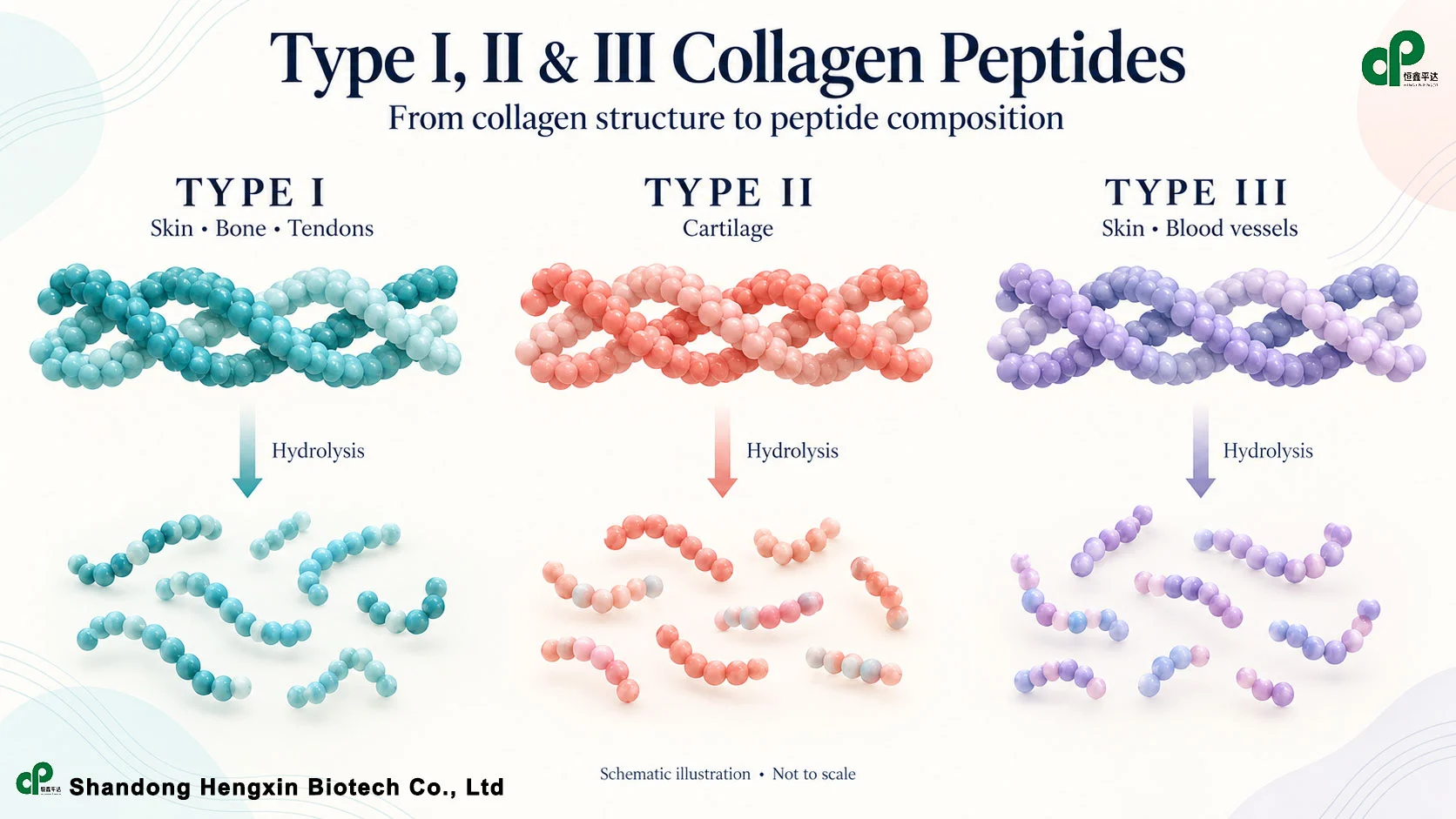
To compare these types of collagen peptides, we first need to understand whole proteins, their structure, and how they work. Then, we will look at how hydrolyzed peptide mixtures change. In this guide, we will break it down step by step so you can choose the right collagen product for you.
Types I, II, and III are fibril-forming collagens. All three have a triple helix, but their α-chain composition differs. They also form different structures within tissues.
Collagen type | Typical chain composition | Main tissue locations | Structural role |
Type I | [α1(I)]₂α2(I) | Skin, bone, tendons, ligaments | Provides tensile strength; forms part of the matrix that becomes mineralized in bone |
Type II | [α1(II)]₃ | Cartilage, including articular cartilage | Forms the collagen network that helps cartilage retain its shape under load |
Type III | [α1(III)]₃ | Skin, blood vessel walls, and other soft tissues | Supports tissue structure and helps regulate Type I fibril formation |
Type I usually contains two α1(I) chains and one α2(I) chain. Types II and III each contain three identical chains of their respective type. These differences are part of the proteins' molecular structure.
Type I collagen forms a major part of tendons, skin, and bone. Its role depends partly on how its fibrils are arranged and what surrounds them. Tendons contain closely aligned fibers. Bone combines a collagen matrix with mineral. This is why Type I should not be reduced to "skin collagen." The same collagen type serves several tissues with different mechanical demands.
Type II forms the main collagen network in articular cartilage. That network works with proteoglycans and water to support load and resist deformation. Calling Type II a "joint cushion" leaves out this shared structure. Cartilage function depends on the whole matrix, including how these components interact.
Type III often occurs alongside Type I. Its role includes helping organize collagen fibrils. In a gene-disruption study, mice lacking Type III collagen developed abnormal Type I fibrils and serious cardiovascular defects. This supports Type III's role in tissue formation. It does not establish a benefit from taking Type III peptides by mouth.
In its natural, native state, collagen is a large and structurally complex protein. Whether it is Type I and Type III collagen found in the skin, bones, and blood vessels, or Type II collagen found in joint cartilage, native collagen has a stable triple-helix structure with a molecular weight of about 300,000 daltons. Hydrolysis breaks intact collagen into shorter peptide chains, which are commonly known as "hydrolyzed collagen" or "collagen peptides."
The originally tightly wound triple-helix structure is broken down, and the molecular weight decreases from about 300,000 daltons to typically 2,000–5,000 daltons, or even to smaller oligopeptides of only a few hundred daltons. This is the most direct change caused by hydrolysis and the basis for all the changes that follow.
Non-hydrolyzed collagen is almost insoluble in water and cannot be directly absorbed and utilized by the intestine. After hydrolysis, the smaller peptide fragments become soluble in cold water and can pass through the intestinal barrier more easily and enter the bloodstream. This is also why hydrolyzed collagen is commonly made into powders and beverages for convenient daily supplementation.
Native collagen acts like "reinforcing steel" in a building, providing structural support for the skin, bones, and cartilage. After hydrolysis, this mechanical support function is largely lost, but the resulting peptide fragments are believed to act as signaling molecules that stimulate fibroblasts, chondrocytes, and other cells to produce collagen themselves. This is also the basis for many collagen peptide products claiming that they can "promote the body's own collagen regeneration."
Most commercially available collagen peptides are derived from animal sources, including skin, hides, bones, scales, and cartilage. Animal-derived raw materials should be supported by complete traceability documentation to help ensure food safety. As a collagen peptide manufacturer, we clearly identify the animal species, relevant disease risks(such as BSE), and the food-grade status of the raw materials.
Raw Material | Typical Collagen Association before Hydrolysis |
Bovine or porcine skin | Types I and III |
Fish skin and scales | Mainly Type I |
Bone | Mainly Type I |
Chicken or bovine cartilage | Rich in Type II |
These are source patterns, not fixed specifications for every finished powder. A cartilage-derived ingredient may also contain other matrix components, depending on extraction and purification.
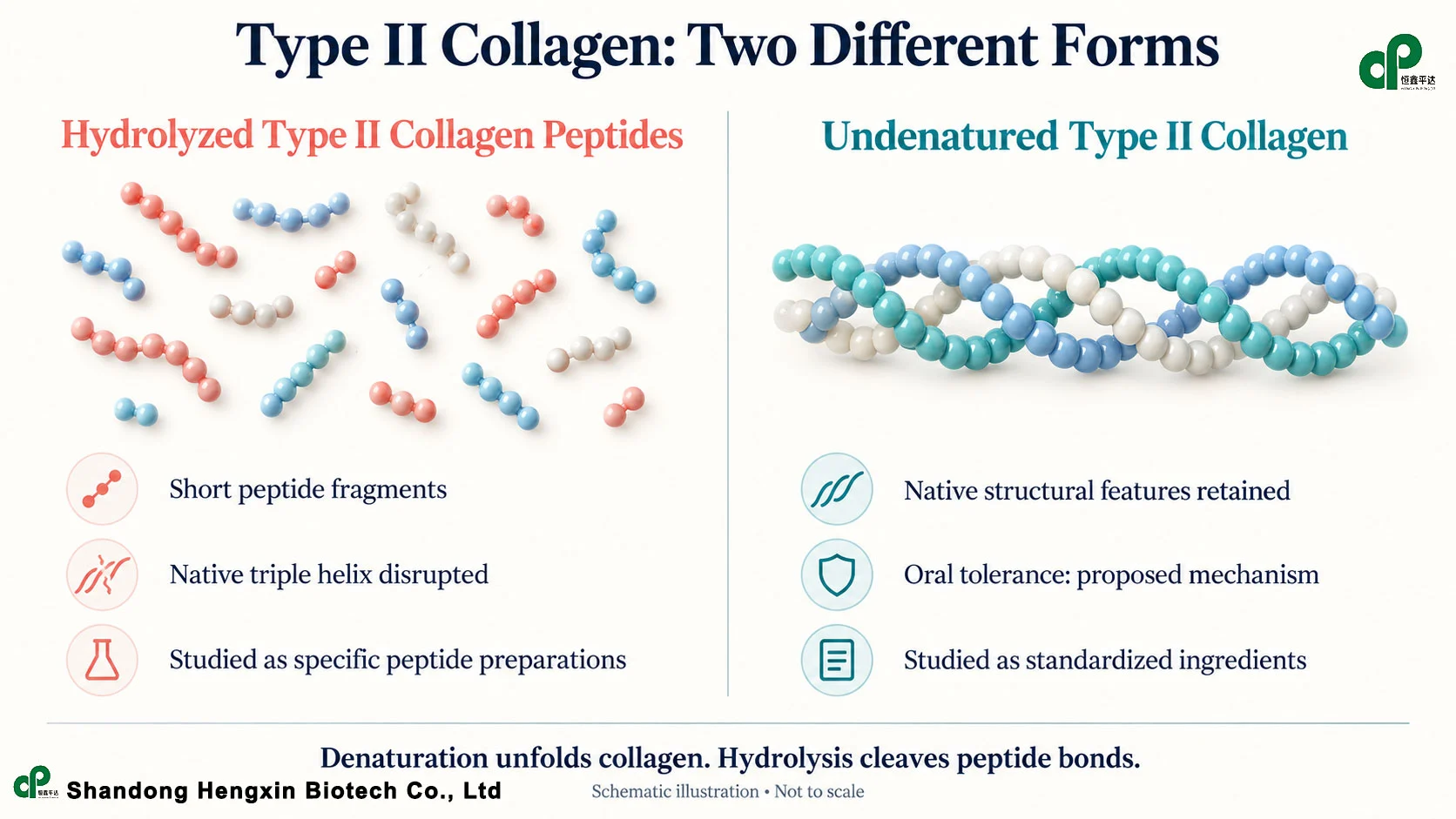
Type II can appear in a hydrolyzed ingredient or an undenatured ingredient. These forms should remain separate when comparing mechanisms, amounts, and study results.
Feature | Hydrolyzed Type II collagen | Undenatured Type II collagen |
Processing goal | Break collagen into smaller peptides | Preserve relevant native structural features |
Research focus | Peptide composition, digestion, and biological effects | Oral tolerance and joint-related outcomes |
Dose comparison | Use the specified hydrolysate and its studied amount | Use the specified standardized ingredient and its studied amount |
Oral tolerance is a proposed mechanism for undenatured Type II collagen. A clinical improvement in joint movement does not, by itself, confirm that mechanism. A 2013 randomized, double-blind trial enrolled 55 people who experienced knee discomfort during strenuous exercise. Participants received 40 mg of UC-II daily or placebo for 120 days. At day 120, average knee extension was 81.0° in the UC-II group versus 74.0° in the placebo group, with p = 0.011. The trial was small and studied a specific ingredient in a defined population.
Notice: The 40 mg figure refers to the study ingredient. It should not be presented as 40 mg of pure undenatured collagen or as a universal dose for every Type II product. Nor should it be compared gram-for-gram with a hydrolyzed powder to calculate which is "more powerful."
Evidence on collagen peptide efficacy currently clusters around three areas: skin, joints, and bone. The strength of that evidence is not uniform across the three, so they're worth treating separately rather than as equally proven.
A 2023 systematic review and meta-analysis published in Nutrients pooled 26 randomized controlled trials with 1,721 participants. The results show that compared to the placebo group, hydrolyzed collagen (HC) supplementation significantly improved skin hydration (overall effect test: Z = 4.94, p < 0.00001) and elasticity (overall effect test: Z = 4.49, p < 0.00001). There were no significant differences in the impact on skin elasticity based on the different sources of collagen (p = 0.21) or the corresponding measurement methods (p = 0.06). Another 2025 review of 23 randomized controlled trials also indicates that collagen peptides are indeed beneficial.
A 2023 meta-analysis in the Journal of Orthopaedic Surgery and Research included four randomized trials totaling 507 patients with knee osteoarthritis and found a statistically significant reduction in pain for the collagen peptide group compared with placebo, though the studies were rated as high risk of bias, and no significant difference emerged in adverse event rates. In short, the joint-health signal exists, but the underlying studies are still thin and not fully consistent.
A 12-month, randomized, placebo-controlled, double-blind study followed 131 postmenopausal women with age-related bone density loss, and the group receiving specific collagen peptides showed significantly greater increases in bone mineral density at the spine and femoral neck compared with the control group. Participants received either 5 g of specific collagen peptides or 5 g of maltodextrin as a placebo daily for 12 months, with bone mineral density measured by DXA. This is a long-duration, well-controlled trial, though it's a single study rather than a pooled meta-analysis.
Several of the higher-quality RCTs in this field were funded by collagen ingredient manufacturers. That doesn't invalidate the findings, but any efficacy claim should disclose funding source and sample size rather than using a blanket "clinically proven." For consumers and B2B buyers, requesting relevant documentation from sellers is the fastest and most direct way.
Skin evidence is comparatively solid, joint evidence is moderate-strength, and bone evidence is long-duration but still based on a limited number of trials — the three shouldn't be presented as equally settled.
Two collagen products can look alike on the shelf and be very different in the scoop. With the types and hydrolysis basics above in mind, here are five checks to run on any label.
Look for "collagen peptides," "hydrolyzed collagen," or "collagen hydrolysate" for the peptide form we've discussed. "Undenatured type II collagen" is a different ingredient with a different dosing logic, so compare it with other type II products, not with peptide powders. Labels rarely say Type I, II, or III outright, but the source (bovine, marine, or chicken) is a useful clue.
Hydrolyzed collagen is usually dosed in grams, while undenatured type II collagen is usually dosed in milligrams. A 40 mg product and a 10 g product aren't a like-for-like comparison. Check the serving size and servings per container, then compare the cost per gram of collagen.
If a label lists only the total weight of a blend, you can't tell how much collagen you're actually getting. For multi-collagen products, look for amounts listed by type or source.
Added sugars, sweeteners, flavors, and fillers all affect what's in each scoop. Extras like vitamin C or hyaluronic acid are only meaningful if the amount is listed.
Seals such as NSF Certified, USP Verified, or Informed Choice indicate independent verification, whereas terms like "clean" or "premium" don't. Marine-sourced products should carry a fish allergen statement.
Finally, treat dramatic promises like "reverses aging" with caution. The familiar "not evaluated by the FDA" disclaimer is a reminder that supplements aren't approved to treat or cure disease.
Behind every label is a supplier's Certificate of Analysis (COA). If you're sourcing fish collagen peptides for your own product, our guide How to Read a Fish Collagen Peptide COA Like a Procurement Engineer covers molecular weight distribution, hydroxyproline, protein basis, heavy metals, microbial results, and the red flags to watch for. It's worth a read before you approve your next supplier.
Now that you have read the full article, you probably know that Type I and Type III are the main structural collagens in your skin, bones, and connective tissues, while Type II collagen is mostly found in cartilage. When comparing products, taking an objective and thoughtful approach can help you find the one that best fits your needs.