 zh-CN
zh-CN


Jun 04-2026
What Is Bovine Gelatin Used For? A Complete Industrial & Pharmaceutical Guide
READ MORE >
2026-08-21
In commercial procurement, fish collagen peptides and bovine collagen peptides are standard food ingredient supplements. Each comes from a different source, so source alone doesn't determine performance. Fish peptides are rich in Type I collagen. Bovine collagen contains both Type I and Type III collagen.
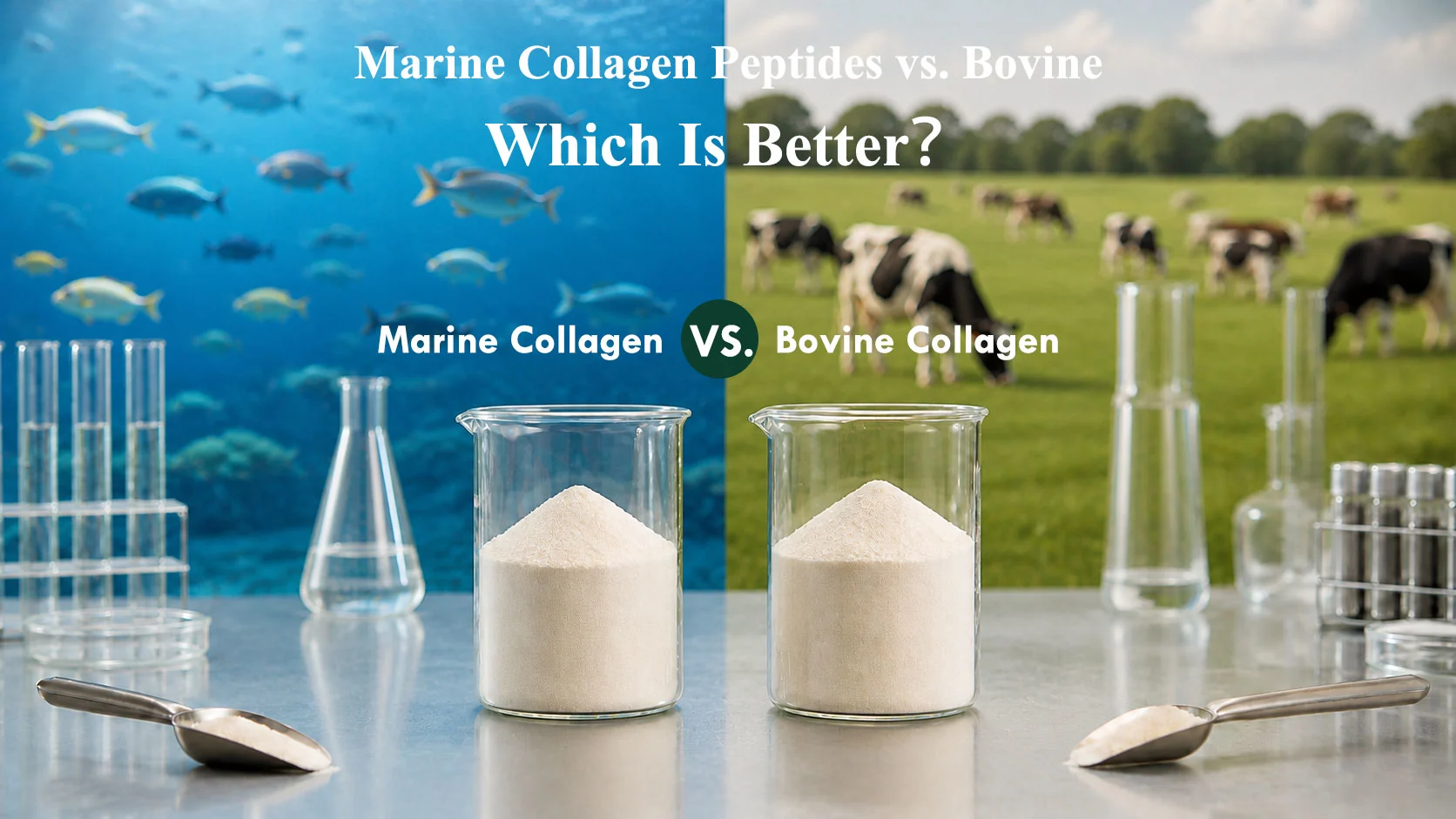
It depends on your formula, target market, label, price point, and supply needs. This guide breaks down marine collagen peptides vs. bovine side by side, so you can pick the right fit fast. We also have a guide to reading collagen specifications and a walkthrough of collagen applications in nutraceuticals, if you want to go deeper.
Marine and bovine collagen peptides have similar amino acid profiles. But they differ in source, market positioning, labeling requirements, cost, and product specifications.
Marine collagen peptides mainly contain Type I collagen. It works well in cold-water beverages and beauty supplements. Bovine collagen peptides contain both Type I and Type III collagen, usually cost less than marine collagen peptides.
Bioavailability depends largely on the hydrolysis process and peptide profile. You can't judge absorption based on the source alone. Bovine collagen hydrolysates need relevant Halal or Kosher certification when sold to Muslim or Jewish markets.
For B2B buyers, the right choice depends on the formulation, target market, certification requirements, clean-label, price positioning, and supply needs.
Fish collagen peptides, also known as marine collagen peptides, are primarily sourced from fish skin, bones, and scales. Commercial sources feature deep-sea cold-water fish like cod, salmon, and red snapper, alongside tilapia. Pangasius and catfish are also used in smaller quantities. Read our article on fish collagen peptides to learn more.
Clinical studies on fish-derived collagen peptides suggest that regular oral supplementation may help support skin hydration, elasticity, and the appearance of wrinkles.
Broader research on hydrolyzed collagen also supports these potential benefits. A 2023 meta-analysis covering 26 randomized controlled trials and 1,721 participants found improvements in skin hydration and elasticity with oral hydrolyzed collagen supplementation.
For product developers, marine collagen peptides may also be attractive because they can be formulated into powders, functional beverages, and beauty supplements, while offering a fish-derived alternative to bovine collagen.
Bovine collagen comes from cattle hides and bones. Processors extract bovine collagen using heat, acid, or alkaline treatment. Then they hydrolyze it into peptides, just like the fish process. For a closer look at its sources and common uses, read our article on what bovine collagen peptode is.
"Collagen peptides" is the umbrella term. It covers any hydrolyzed collagen, no matter the animal source. Marine collagen peptides are one type under that umbrella — the type sourced from fish.
You probably want a clear, direct comparison between marine collagen peptides and bovine collagen peptides. Here are the key differences:
“Marine collagen” and “collagen peptides” describe different attributes: the source and the processed form. See our guide to marine collagen vs. collagen peptides for the full breakdown.
Human skin holds about 80–90% Type I collagen and 8–15% Type III collagen. Type I provides strength and structure. Type III helps support a more flexible collagen network. Marine collagen peptides are almost entirely Type I. Bovine collagen peptides carry both Type I and Type III, close to the same ratio found in human skin.
Some brands use this Type I + III story to sell bovine collagen. It's a fair point — both types support skin health. But your body breaks all ingested collagen down into amino acids and small peptides anyway. Once digested, the peptide source matters less than you'd think.
What matters more is molecular weight. A well-hydrolyzed marine collagen peptide, under 3,000 Daltons, performs on par with bovine collagen in skin hydration studies. The type ratio becomes a marketing detail, not a performance gap.
Marine and bovine collagen share a similar amino acid backbone. Glycine makes up about a quarter of each. Proline and hydroxyproline together make up another quarter.
The table below is based on tested data for Hengxin fish collagen peptides and bovine collagen peptides: (Units: grams per 100 grams of protein)
| Amimo Acids | Marine Collagen (Tilapia) | Bovine Collagen | What It Does |
| Glycine | 20-25 g | 20-25 g | Structural support; aids sleep and glutathione production |
| Proline | 10-12 g | 10-12 g | Core building block of the collagen triple helix |
| Hydroxyproline | 8-10 g | 10-12 g | A characteristic amino acid of collagen, stabilizes the helix |
| Alanine | 8-10 g | 7-9 g | General structural amino acid |
| Arginine | 7-9 g | 7-8 g | Supports circulation; nitric oxide precursor |
(Grams per 100 grams of protein, data sourced from Hengxin R&D)
Three other published studies show a similar overall trend. One PMC-indexed study examined the composition and properties of fish collagen. The data are shown below:
Another study focused specifically on the characteristics of tilapia-derived collagen hydrolysate.Its experimental data are shown below:
A study published in ScienceDirect compared the amino acid profiles of collagen sourced from pigskin, fish skin and bovine bone. All three sources exhibited similar amino acid compositions, but fish skin collagen had a lower hydroxyproline content.
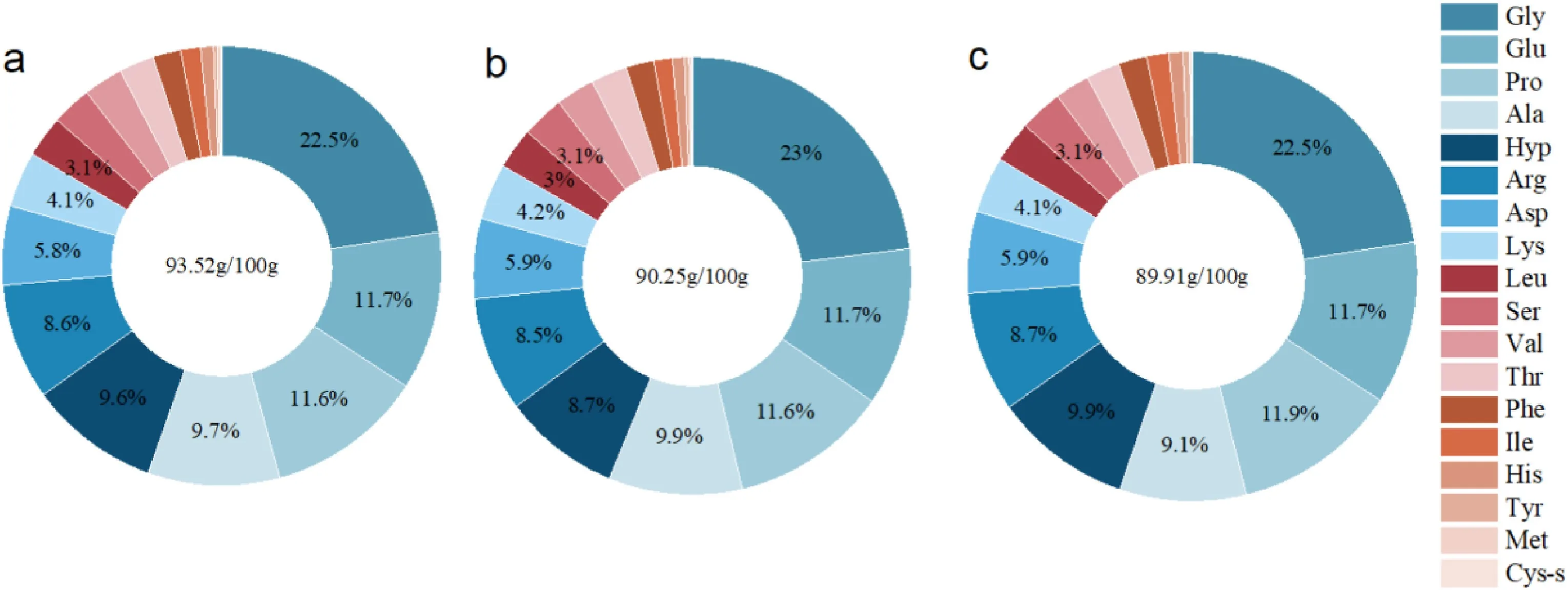
(a) collagen from pigskin, (b) collagen from fish skin, (c) collagen from bovine bone
Bottom Line: Neither source has a clear advantage based on amino acid composition alone. Bovine collagen often contains relatively high levels of proline and hydroxyproline, while warm-water fish such as tilapia can show a very similar profile.
Source note: Hengxin values are based on internal product testing. Published studies are cited to provide general scientific context.
Marine collagen is often marketed as more bioavailable than bovine collagen. However, the source alone does not determine absorption.
Human studies show that both fish and bovine collagen hydrolysates deliver collagen-derived amino acids and small peptides into the bloodstream. Current evidence does not show that collagen consistently provides higher bioavailability simply because it comes from fish.
Instead, hydrolysis conditions and the final peptide profile play a major role. Research comparing bovine collagen hydrolysates with different molecular weights found that the lower-molecular-weight product produced higher total hydroxyproline exposure. Other clinical studies also suggest that further enzymatic hydrolysis can improve the absorption rate of collagen-derived amino acids.
For B2B buyers, the important question is "How well does the manufacturer control the peptide profile?" You can verify this information with the manufacturer before making a final determination:
molecular weight distribution.
percentage of low-molecular-weight peptides.
hydrolysis process and consistency.
hydroxyproline content.
batch-to-batch specifications.
supporting test methods and technical data.
Rather than focusing only on bioavailability, brand owners should consider their target market and formulation needs.
Fish-derived collagen may be easier to use in some Halal or Kosher sensitive product categories. Buyers should verify the fish species, processing conditions, manufacturing and relevant third-party certification.
Bovine collagen requires documentation of the cattle source and slaughter method to qualify for Halal certification. Kosher certification is stricter and requires rabbinical supervision, which many cattle suppliers cannot provide. Hengxin offers both Halal and Kosher certified bovine collagen peptides.
Fish is classified as a major allergen in many markets. Products containing fish collagen must declare fish on the label. Some studies found no allergic reactions to fish collagen peptides in people with confirmed fish allergies. Brand owners need to clearly define labeling requirements. For some consumers, the word “fish” on the label may also affect purchase decisions.
Bovine collagen carries no mandatory allergen label. That's an advantage if your target market has a high rate of fish allergy or label sensitivity.
Fish and bovine collagen peptides offer similar core benefits. The bigger decision factors are market needs, religious requirements, sustainability preferences, and price.
Product format: Hengxin recommends high-quality fish collagen peptides for clear beverages and cold-water applications. For gummies and functional foods, both of them work well.
Target market: Religious and cultural requirements can influence the choice. Fish collagen may be easier to position in some Halal-sensitive markets. Bovine collagen can also meet Halal or Kosher requirements when properly certified.
Price position: Bovine collagen is often more cost-effective for mass-market products. Fish collagen usually carries a higher price.
Consumer preference: Some consumers prefer marine-sourced ingredients. Others focus more on price, convenience.
Formulation performance: Test both materials in your actual formulation. Solubility, taste, clarity, and stability may differ between suppliers and specifications.
Yes, Some of our clients blend marine and bovine collagen in one product. This combines bovine's cost advantage with marine collagen's solubility and taste edge. A 50:50 blend often dissolves better than pure bovine and costs less than pure marine.
Blending also gives you a richer ingredient story: "Type I collagen from sustainably farmed tilapia, blended with Type I + III collagen from traceable cattle hides." That line does more work than naming either source alone.
Fish collagen peptides come from the skin and scales of farmed fish. Processors extract the collagen and break it into small peptides through enzymatic hydrolysis.
"Collagen peptides" covers any hydrolyzed collagen source. Marine collagen peptides are the fish-derived version, known for high Type I content, low molecular weight, and strong cold-water solubility.
Neither source is automatically absorbed faster. Absorption is influenced by hydrolysis conditions, molecular weight distribution, peptide profile, and the finished ingredient specification. Brand Owners should compare technical data and test.
People with fish allergies should not assume that marine collagen peptides are suitable for them. Fish-derived collagen still fall under fish allergen labeling requirements, depending on the target market and applicable regulations. For product manufacturers, the key issue is therefore not to claim that fish collagen is safe for people with fish allergies, but to verify allergen requirements, labeling obligations, and supplier documentation.
Well-processed marine collagen peptides can have a mild taste and low odor, but sensory performance varies between products. Fishy odor can be influenced by raw material freshness, processing, oxidation control, purification, and storage conditions.
Buyers evaluating marine collagen for beverages or flavored products should therefore request samples and conduct sensory testing in the actual formulation.
Not safely. Even with similar specs on paper, the two sources behave differently in a live formula. Run a full bench trial and stability test before switching.
The better collagen peptide is the one that fits your formula, your budget, and your customer. For some brands, that's marine. For others, that's bovine. For a growing number, it's both.
Hengxin produces marine collagen peptides from farmed tilapia skin and scales, and bovine collagen peptides from traceable cattle hides. Every batch ships with a full COA, amino acid profile, and application-specific grade recommendation.
Not sure which source fits your product? Contact us. We'll ask about your formula, your target market, and your cost target — then recommend a grade and send samples so your R&D team can run its own bench comparison.